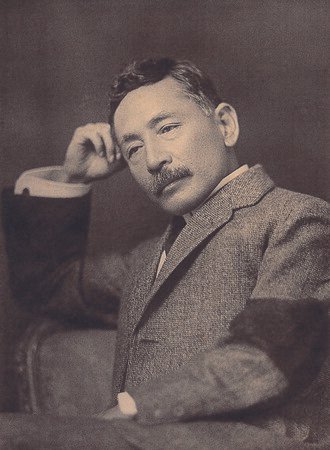
 AuthorNatsume Sōseki1867–1916
I Am a Cat is a satirical novel by the Japanese writer Natsume Sōseki, written between 1905 and 1906. It was published in installments in the literary magazine Hototogisu, across ten chapters. Sōseki originally meant to write only the first, a short story, but the editor Takahama Kyoshi persuaded him to continue, and the work changed in style as the installments appeared. Almost every chapter can be read on its own.
The narrator is an unnamed cat who watches the life of the Japanese middle class in the Meiji era (1868–1912) with a haughty, learned air. This was a conservative society opening itself to Western modernization. The cat lives in the house of a teacher, Mr. Kushami, whose habits, intellectual pretensions and small daily miseries give the book its thread. Around him move his friend Meitei, a prankster who amuses himself by inventing quotations and twisting other people's ideas, and a circle of neighbours and students who adopt a cultivated pose without quite understanding it. References to Western artists and figures, such as Thackeray, Lafcadio Hearn or Shigenobu Ōkuma, reflect the fascination and bewilderment that European culture provoked.
Satire is the heart of the book. The cat mocks the eagerness to seem modern, the pedantry and the vanity of the middle class, and in doing so reveals the tension between Japan's traditional heritage and the model of civilization imported from abroad. The novel offers no tidy answers; it offers an ironic gaze that invites both a smile and reflection on cultural identity.
Its reception has been long-lasting. It remains a common reading in Japanese schools, and its tone left a mark on later literature. The narrator's deliberately archaic and pompous way of speaking became associated with this book, and the pronoun he uses still appears in fiction to characterize arrogant animals. The work was adapted into films in 1936 and 1975, and into an animated television special in 1982.
Themes
Other works by Natsume Sōseki
- Kairo-kō 1905
- Botchan 1906
- The Three-Cornered World 1906
- Nowaki 1907
- Ten Nights of Dreams 1908
- Sanshirō 1908
- The Miner 1908
- The Wayfarer 1912
- Kokoro 1914
- Grass on the Wayside 1915
- And Then
Original Filopedia text based on Wikipedia (es) and Wikipedia (en) and Wikidata.