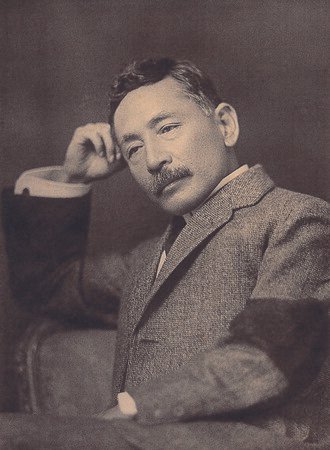
 AuthorNatsume Sōseki1867–1916
Sanshirō is an 1908 novel by the Japanese writer Natsume Sōseki. It is the first part of a trilogy that continues with Sorekara (1909) and The Gate (1910). It was serialized in the newspaper Asahi Shimbun between September and December 1908 and published as a book the following year.
The novel follows Sanshirō Ogawa, a young man from the Kyushu countryside in southern Japan, who travels to Tokyo to study at the university. Fresh out of high school in Kumamoto, he finds the modernizing city bewildering, as well as his fellow students, professors and a memorable cast of characters who teach him how to get along. Among them stand out the scheming Yojirō, whose meddling often lands Sanshirō in trouble, and Professor Hirota, an amateur philosopher who warns him about the hidden dangers beneath society's polished surface.
The story unfolds over a single semester and is largely a coming-of-age tale. Sanshirō discovers three worlds to which he belongs: that of his hometown and his mother, that of intellectual life, and that of human emotion, embodied in his attraction to Mineko. His growth is gradual, however, and he is far from master of his own future. Through Sanshirō and those around him, Sōseki comments on Meiji-era society, the recent Russo-Japanese War, Western science, the place of women and the tensions of modernization.
Today Sanshirō is among the most widely read of the author's works and the opening of a trilogy that explores the clash between tradition and modernity in early twentieth-century Japan.
Themes
Other works by Natsume Sōseki
- Kairo-kō 1905
- Botchan 1906
- The Three-Cornered World 1906
- Nowaki 1907
- Ten Nights of Dreams 1908
- The Miner 1908
- The Wayfarer 1912
- Kokoro 1914
- Grass on the Wayside 1915
- I Am a Cat
- And Then
Original Filopedia text based on Wikipedia (es) and Wikipedia (en) and Wikidata.