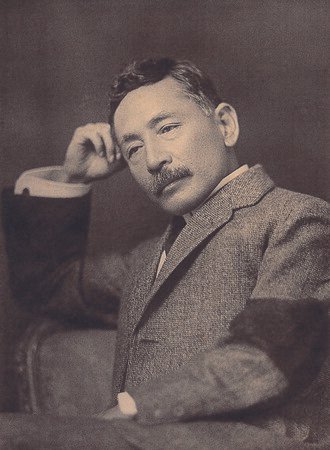
 AuthorNatsume Sōseki1867–1916
Kairo-kō is a novel published in 1905 by the Japanese writer Natsume Sōseki. It is the earliest and, practically speaking, only major treatment of the Arthurian legend in Japanese prose, and it follows the adulterous love triangle formed by Lancelot, Guinevere and Elaine of Astolat. It is considered one of Sōseki's first novels and helped establish him as the leading novelist of the Meiji era.
The work was written shortly after Sōseki's stay in the United Kingdom between 1901 and 1903, a period during which he studied medieval and contemporary British literature and which he found unpleasant. Like other works from the same time, such as the short story "Rondon tô" ("The Tower of London"), it reflects that experience. His main sources were Thomas Malory's Le Morte d'Arthur and Alfred, Lord Tennyson's Arthurian poetry, especially "The Lady of Shalott", with echoes also of Tennyson's Idylls of the King and Spenser's The Faerie Queene.
The novel has a short introduction and five sections, each with its own title: "The Dream", "The Mirror", "The Sleeve", "The Transgression" and "The Boat". The narrative moves through lyrical scenes and passages meditating on the pain and sorrow tied to passionate love. Its blend of medieval and Victorian Western material with Japanese and Chinese forms, together with a deliberately archaic style, gives it a distinctive character. The theme of adultery, which Sōseki would return to in much of his later work, is central. Some critics have controversially suggested an autobiographical reading involving his sister-in-law.
Themes
Other works by Natsume Sōseki
- Botchan 1906
- The Three-Cornered World 1906
- Nowaki 1907
- Ten Nights of Dreams 1908
- Sanshirō 1908
- The Miner 1908
- The Wayfarer 1912
- Kokoro 1914
- Grass on the Wayside 1915
- I Am a Cat
- And Then
Original Filopedia text based on Wikipedia (en) and Wikidata.