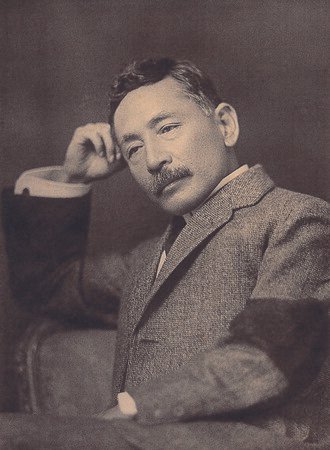
 AuthorNatsume Sōseki1867–1916
The Wayfarer (Kōjin) is a novel by the Japanese writer Natsume Sōseki, serialised in the newspaper Asahi Shimbun between December 1912 and November 1913. It forms the second part of a trilogy that begins with To the Spring Equinox and Beyond and ends with Kokoro, and it belongs to the final phase of Sōseki's work, when short chapters and an oblique narrative approach had become characteristic of his fiction. It is divided into four parts, each subdivided into chapters of a page or two. Although each section reads almost as an independent story, the whole is bound together by a single underlying conflict.
The novel is narrated in the first person. The first three parts are told by Jirō Nagano, a young unmarried office worker in Tokyo, and the fourth takes mostly the form of letters written by Mr. H, a colleague of Ichirō. This shift of voices offers differing views of the true protagonist, Ichirō, Jirō's elder brother and a university professor. His suspicion of his wife Nao and his inability to adapt to a world in which traditional values are crumbling make him an embodiment of the anguish of the modern individual, cut off even from his own family.
The central plot follows the delicate triangle formed by Ichirō, Jirō and Nao, with its mounting suspicions, family tensions and growing distance between the brothers. The novel is remembered for its subtle psychological analysis and its indirect way of presenting events, and it is often read as one of the great explorations of solitude and modern consciousness in Japanese literature.
Themes
Other works by Natsume Sōseki
- Kairo-kō 1905
- Botchan 1906
- The Three-Cornered World 1906
- Nowaki 1907
- Ten Nights of Dreams 1908
- Sanshirō 1908
- The Miner 1908
- Kokoro 1914
- Grass on the Wayside 1915
- I Am a Cat
- And Then
Original Filopedia text based on Wikipedia (es) and Wikipedia (en) and Wikidata.