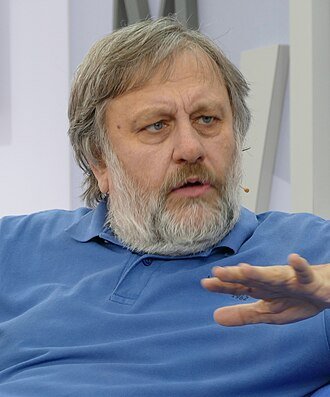
Slavoj Žižek
b. 1949 · Slovenian philosopher, psychoanalyst and cultural critic
Origins and family
Slavoj Žižek was born on 21 March 1949 in Ljubljana, capital of the Socialist Republic of Slovenia, then part of Yugoslavia. He came from a middle-class, atheist family tied to the state: his father, Jože Žižek, was an economist and civil servant from the region of Prekmurje in eastern Slovenia, while his mother, Vesna, a native of the Gorizia Hills in the Slovenian Littoral, worked as an accountant in a state enterprise. He spent most of his childhood in the coastal town of Portorož, where he was exposed to Western film, theory and popular culture.
Adolescence and early interests
As a teenager his family moved back to Ljubljana, and he attended Bežigrad High School. He had initially hoped to become a filmmaker, but gave up those ambitions and chose philosophy instead. Before entering university he had already been reading the French structuralists, and in 1967 he published the first Slovene translation of a text by Jacques Derrida. He frequented circles of dissident intellectuals, among them the Heideggerian philosophers Tine Hribar and Ivo Urbančič, and wrote for alternative magazines such as Praxis, Tribuna and Problemi, which he also edited.
Academic training
In 1967, during the liberalising period of Titoist Yugoslavia, he enrolled at the University of Ljubljana to study philosophy and sociology. In 1971 he accepted a post as assistant researcher with the promise of tenure, but was dismissed after the authorities denounced his master's thesis as "non-Marxist". He graduated in 1981 with a doctorate in philosophy on the theoretical and practical relevance of French structuralism. He later described the next few years as a "professional wilderness": four years of national service in the Yugoslav People's Army in Karlovac, followed by four years without work. In 1986 he completed a second doctorate, in psychoanalysis, at the University of Paris VIII under Jacques-Alain Miller, with a dissertation titled "La philosophie entre le symptôme et le fantasme".
Early work and international recognition
During the 1980s he edited and translated Jacques Lacan, Sigmund Freud and Louis Althusser, and used Lacan's work to read Hegelian and Marxist philosophy. In 1988 he published Pogled s strani, his first book devoted entirely to film theory. The following year, 1989, saw the publication of The Sublime Object of Ideology, his first book in English, which brought him international recognition as a social theorist. In it he moved away from traditional Marxist theory to propose a materialist conception of ideology drawing heavily on Lacanian psychoanalysis and Hegelian idealism. He has since published in outlets including the New Left Review, the London Review of Books and In These Times, and writes for Slovenian and Polish publications.
Political activity
In the late 1980s he became known as a columnist for the alternative youth magazine Mladina, which was critical of Tito's policies and of the militarisation of society. He remained a member of the League of Communists of Slovenia until October 1988, when he quit in protest at the JBTZ trial, along with 32 other Slovenian intellectuals. Between 1988 and 1990 he took part in civil society movements fighting for Slovenian democratisation, most notably the Committee for the Defence of Human Rights. In the first free elections of 1990 he stood as the Liberal Democratic Party's candidate for the former four-member collective presidency and came close to winning, placing fifth in the vote count. He later joined the Democracy in Europe Movement 2025 (DiEM25), founded in 2016.
International career and style
His academic career took him to visiting posts at Columbia, Princeton, the New School for Social Research in New York and the University of Michigan. From 2004 until September 2025 he was international director of the Birkbeck Institute for the Humanities at the University of London, and he is also a Global Distinguished Professor of German at New York University. His idiosyncratic manner, marked by obscene jokes, pop-cultural examples and deliberately politically incorrect provocations, has earned him fame and controversy both inside and outside academia. In 2012 Foreign Policy named him to its list of the Top 100 Global Thinkers, calling him "a celebrity philosopher". He has been dubbed the "Elvis of cultural theory", and the International Journal of Žižek Studies was founded to engage with his work.
Personal life and tastes
He has been married four times and has two adult sons, Tim and Kostja. His second wife was the Slovene philosopher Renata Salecl; his third, the Argentinian model and psychoanalyst Analia Hounie, whom he married in 2005; and he is currently married to the Slovene journalist and philosopher Jela Krečič. Besides Slovene, he speaks Serbo-Croatian, French, German and English fluently. His favourite films, in a 2012 Sight & Sound poll, ranged from 3:10 to Yuma to The Sound of Music, and in music he has praised Schoenberg, Wagner and Eisler.
Legacy and reception
His work has been the subject of documentaries such as Zizek! (2005) by Astra Taylor, and of The Pervert's Guide to Cinema (2006) and The Pervert's Guide to Ideology (2012). Supporters regard him as the leading Hegelian of our time and the foremost exponent of Lacanian theory, while critics fault his often obscure writing and imprecise terminology. His influence is felt both in academia and in public debate on ideology, international politics and popular culture.
Key ideas
- Ideology as fantasy: ideology is not just a set of false beliefs but what sustains our way of life even when we do not fully believe it.
- The real: a traumatic core that cannot be symbolised and that leaves reality incomplete and inconsistent.
- The symbolic and the imaginary: language that organises meaning set against our identification with images of ourselves.
- Popular culture as method: films and jokes make abstract theoretical structures visible.
Curiosities
A text for a clothing brand
In 2003 he wrote the text accompanying Bruce Weber's photographs in an Abercrombie & Fitch catalogue. Asked about it, he said he would gladly take such work over becoming a tenured American academic.
A paralysis turned into a metaphor
In 2018 he suffered facial paralysis on the right side of his face. During a lecture in London he used his condition as a metaphor for political inaction.
Narrowly missed
In the first free elections of 1990 he ran for the former collective presidency of Slovenia as the Liberal Democratic Party's candidate. He finished fifth in the vote, only narrowly missing election.
Teachers and influences
Influenced by
- Karl Marx 1818–1883
- Friedrich Nietzsche 1844–1900
- Immanuel Kant 1724–1804
- Sigmund Freud 1856–1939
- Mao Zedong 1893–1976
- Georg Wilhelm Friedrich Hegel 1770–1831
- Søren Kierkegaard 1813–1855
- Martin Heidegger 1889–1976
- G. K. Chesterton 1874–1936
- Theodor W. Adorno 1903–1969
- Walter Benjamin 1892–1940
- Friedrich Wilhelm Joseph Schelling 1775–1854
- Jacques Lacan 1901–1981
- Louis Althusser 1918–1990
- Alain Badiou b. 1937
- Fredric Jameson 1934–2024
- Ernesto Laclau 1935–2014
- Jacques-Alain Miller b. 1944
Original Filopedia text based on Wikipedia (es) and Wikipedia (en) and Wikidata.