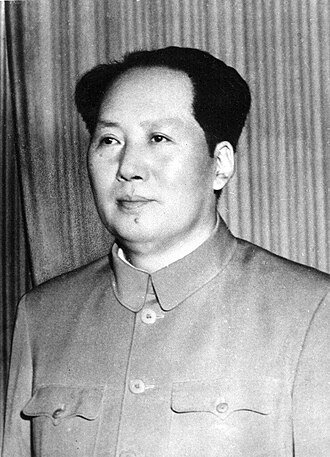
Mao Zedong
1893–1976 · Chinese revolutionary, political theorist and founder of the People's Republic of China
Mao Zedong (Shaoshan, Hunan, 1893 – Beijing, 1976) was a Chinese political leader, thinker and military strategist who led the Chinese Communist Party for most of his adult life and founded the People's Republic of China in 1949. His political thought, known as Maoism, presented itself as a Chinese adaptation of Marxism–Leninism, and it inspired communist movements well beyond China. He remains a deeply contested figure: to some he is the architect of modern China, to others the man responsible for one of the great human catastrophes of the twentieth century.
He was born into a peasant family in the village of Shaoshan. His father was a strict and often harsh man who had risen from poverty to become a relatively prosperous farmer; his mother was a devout Buddhist. As a young man Mao read widely in Western thinkers such as Adam Smith, Montesquieu, Rousseau and Darwin, and he was drawn to the republican ideas behind the Xinhai Revolution of 1911, in which he briefly served as a private soldier. In Beijing, where he worked as an assistant in the university library, he first looked to anarchism and then turned towards Marxism under the influence of Li Dazhao. In 1921 he took part in founding the Chinese Communist Party.
His thinking rested on a central conviction: that revolution in China could not depend mainly on urban workers, as Soviet orthodoxy held, but had to rest on the peasantry. His experience in the countryside and the Long March, which strengthened his hold on the party in the 1930s, reinforced that view. During the Yan'an Rectification Movement of 1942–1945 he consolidated his control over the party and distanced himself from the line set in Moscow. His struggle against the Japanese occupation and against Chiang Kai-shek's Nationalists ended in victory in 1949, reuniting a country that had endured a century of humiliation and loss of sovereignty.
In power he pursued land reform, industrialisation and central planning, and expanded access to education and health care. His political campaigns, however, carried a terrible price. The Anti-Rightist Movement, the Great Leap Forward (1958–1962), which ended in a famine of enormous scale, and the Cultural Revolution, launched in 1966, brought persecution, violence and millions of deaths. After serious health problems he gradually lost day-to-day influence, though he retained near-absolute symbolic authority until his death in 1976. In 1981 the Communist Party officially acknowledged his grave mistakes, while judging his role as revolutionary leader and architect of modern China to outweigh them.
His legacy remains significant. Inside China his image still underpins the party's legitimacy, although the economic reforms that followed under Deng Xiaoping departed from many of his ideas. Abroad, his reputation is divided between those who see an anti-colonial leader and those who see the archetype of an authoritarian regime.
Key ideas
- Peasantry as the engine of revolution: unlike Soviet orthodoxy, Mao argued that in China the decisive revolutionary force was the peasantry rather than the urban proletariat.
- Marxism adapted to Chinese conditions: Maoism aimed to translate Marxism–Leninism into the social and political reality of the country.
- Voluntarism and mass mobilisation: he believed collective will and ideological campaigns could rapidly transform society and the economy.
- Protracted people's war: guerrilla warfare and rural mobilisation were central to his military strategy.
- Permanent class struggle: he held that revolution had to continue after taking power, confronting internal deviations.
Curiosities
A courtesy name
Besides Zedong, Mao had a courtesy name, Rùnzhī, used in adulthood by people outside his family circle.
A voracious reader
As a young man he read Chinese translations of Western authors such as Darwin, Adam Smith and Rousseau.
Teachers and influences
Influenced by
- Peter Kropotkin 1842–1921
- Friedrich Paulsen 1846–1908
Influenced
- Slavoj Žižek b. 1949
- Louis Althusser 1918–1990
- Alain Badiou b. 1937
- Abimael Guzmán 1934–2021
Original Filopedia text based on Wikipedia (es) and Wikipedia (en) and Wikidata.