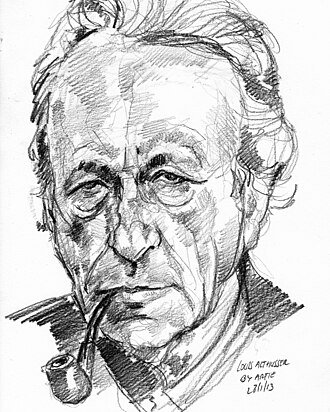
Louis Althusser
1918–1990 · French Marxist philosopher
Louis Althusser (born in Bir Mourad Raïs, French Algeria, 1918; died in Paris, 1990) was a French Marxist philosopher who taught for much of his career at the École Normale Supérieure in Paris. He is usually described as a structural Marxist, although his relationship to French structuralism was never a simple affiliation. His influence reached a generation of left-wing thinkers in Europe and beyond, as well as much of postwar French philosophy.
Born in French Algeria into a lower-middle-class family of Alsatian origin, he moved with his family to Marseille in 1930 and then to Lyon in 1936, where he studied at the Lycée du Parc. There he drew close to Catholicism, briefly considered monastic life and joined a Catholic youth movement, while his sympathy for communism also grew. He was admitted to the École Normale Supérieure in 1939, but his entry was delayed by the war. Drafted that year, he was captured by the Germans in 1940 and spent the next five years in a prisoner-of-war camp in Schleswig-Holstein. Assigned to the infirmary, he had access to books on philosophy and literature, and in his memoirs he recalled that it was in the camp that he first grasped what communism meant. The war left a lasting mark on his mental health, with recurring depression for the rest of his life.
After the war he resumed his studies at the ENS and prepared for the agrégation. His first intellectual period was Hegelian: his 1947 thesis, supervised by Gaston Bachelard, examined Hegel's Phenomenology of Spirit and how Marx's thought retained the master-slave dialectic, although this phase was brief. He joined the French Communist Party in 1948 and soon became a tutor at the school, and from 1954 its secretary for the literary section, a post that placed him at the heart of academic life at the ENS. He organised lectures with figures such as Gilles Deleuze and Jacques Lacan, and his students included Jacques Derrida, Pierre Bourdieu, Michel Foucault and Michel Serres.
His best-known work sought to rethink Marxism against what he saw as theoretical distortions: empiricism, humanist and reformist readings, and the cult of personality. In For Marx and Reading Capital, he proposed reading Marx as a thinker of science rather than of consciousness. In his view Marx had made an epistemological break with his earlier humanist and Hegelian writings, and Marxist theory had to be defined by its scientific concepts: modes of production, social formations and, above all, a history without a central subject, shaped by structures whose parts condition one another. To describe this determination he used the notion of overdetermination, partly drawn from Freud, and the idea of ideological state apparatuses, such as schools, the family, religion or the media, which help sustain the relations of production.
From the late 1960s and through the 1970s his thinking grew more critical of the party and of dogmatic interpretations of Marxism, and he reflected on philosophy as a form of political intervention within theory. His personal life was marked by severe mental crises. In 1980 he killed his wife, the sociologist Hélène Rytmann. He was declared unfit to stand trial by reason of insanity and committed to a psychiatric hospital for three years. He did little academic work afterwards and died in Paris in 1990.
His influence has been twofold. His readings of Marx inspired a strand of Marxist thought that spread across Europe and Latin America. His work on ideology, history without a subject and the theory of structures also became a reference for thinkers as different as Foucault, Derrida or Rancière, although most of them moved away from his central theses.
Key ideas
- Epistemological break: Marx founded a science of history distinct from his humanist and Hegelian youth.
- History without a subject: history is a process without a central subject, shaped by structures whose parts condition one another.
- Overdetermination: every social contradiction depends on many others, so no single one fixes the outcome.
- Ideological state apparatuses: institutions such as schools, the family or religion reproduce the dominant relations of production.
- Theoretical anti-humanism: the individual is an effect of social structures rather than their origin.
Works in Filopedia
- For Marx 1965
Curiosities
A prisoner-of-war camp
During the war he spent five years as a prisoner in Schleswig-Holstein, where he worked in the camp infirmary.
A trial that never happened
After the 1980 killing he was declared unfit to stand trial because of insanity and spent three years in a psychiatric hospital.
Teachers and influences
Teachers
- Jean Hyppolite 1907–1968
Pupils
- Michel Foucault 1926–1984
- Jacques Derrida 1930–2004
- Bernard-Henri Lévy b. 1948
- Marta Harnecker 1937–2019
Influenced by
- Karl Marx 1818–1883
- Mao Zedong 1893–1976
- Benedictus de Spinoza 1632–1677
- Antonio Gramsci 1891–1937
- Claude Lévi-Strauss 1908–2009
- Gaston Bachelard 1884–1962
- Georges Canguilhem 1904–1995
Influenced
- Michel Foucault 1926–1984
- Jacques Derrida 1930–2004
- Slavoj Žižek b. 1949
- Gilles Deleuze 1925–1995
- Alain Badiou b. 1937
- Fredric Jameson 1934–2024
- Étienne Balibar b. 1942
- André Comte-Sponville b. 1952
- Jacques-Alain Miller b. 1944
Original Filopedia text based on Wikipedia (es) and Wikipedia (en) and Wikidata.