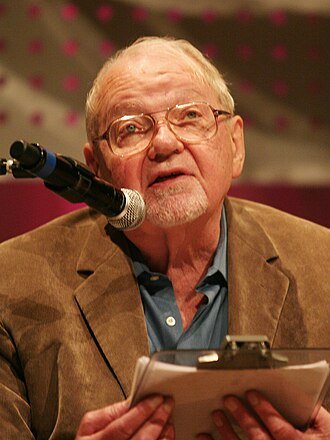
Fredric Jameson
1934–2024 · American literary critic and Marxist cultural theorist
Fredric Jameson (Cleveland, 1934 – Durham, North Carolina, 2024) was one of the most influential literary and cultural critics in the United States in the late twentieth century. Working from a Marxist position shaped by Hegel and the Western Marxist tradition, he spent his career examining how literature and culture relate to the economic and historical conditions that produce them. He is best known for his account of postmodernism as the cultural expression of late capitalism.
After graduating from Haverford College in 1954, he spent a brief period in Europe, studying in Aix-en-Provence, Munich and Berlin, where he encountered continental philosophy and the rise of structuralism. Back in America, he earned his doctorate at Yale under Erich Auerbach, whose historical approach to literary style, attentive to social history, left a lasting mark on him. His dissertation, published in 1961 as Sartre: The Origins of a Style, examined the link between Sartre's writing and his existentialist political and ethical positions, though it set aside the Marxist aspects of Sartre's work, which Jameson took up in the following decade. He taught at Harvard in the early 1960s and from 1967 worked at the University of California, San Diego, where he co-founded a Marxist literary group with his graduate students.
In early books on structuralism, such as The Prison-House of Language (1972), he criticised both the treatment of the artwork as an object cut off from its context and the ahistorical formalism that, in his view, followed from a narrow reading of structuralist method. For him, cultural objects make sense only when placed within their norms and the economic realities behind them.
His central work of maturity is The Political Unconscious (1981), in which he borrows the psychoanalytic notion of the unconscious and applies it to the collective level: narratives are socially symbolic acts that carry repressed ideologies, and ideology works as a strategy of containment that hides a society's contradictions. Jameson held that a historical reading could expose those contradictions and help readers move beyond the dominant ideology. His slogan 'always historicize' sums up this programme.
His best-known text, Postmodernism, or, The Cultural Logic of Late Capitalism, appeared in New Left Review in 1984 and was published as a book in 1991. He argued that postmodernism was the cultural form of a capitalism that had colonised the cultural sphere, previously partly autonomous, and that pastiche had replaced parody, leaving a crisis of historicity. He rejected moral condemnation of postmodernism and analysed it from within, through a Hegelian immanent critique, which led many readers to see his work as an implicit endorsement of its premises.
His influence reached literary criticism, cultural studies, architecture, film and the theory of science fiction, as in Archaeologies of the Future (2005). He received the Holberg Prize in 2008 and taught at Duke University in his final years. He died in September 2024, aged ninety.
Key ideas
- The political unconscious: narratives are socially symbolic acts that reveal historical contradictions repressed by ideology.
- Historicity: every text and culture must be read within its historical and economic context, which is the ultimate horizon of analysis.
- Pastiche versus parody: postmodernism replaces parody's moral judgement with pastiche, a juxtaposition without normative grounding.
- The cultural logic of late capitalism: postmodernism is the cultural expression of a capitalism that absorbs culture and turns it into spectacle and commodity.
- Immanent critique: analysis must work in the same terms as the text studied, in order to develop its internal contradictions.
Curiosities
From structuralism to science fiction
After his early books on structuralism, he spent much of the 1970s studying genres that academia had largely ignored, from science fiction to the hard-boiled novels of Raymond Chandler.
Posts at Harvard and Duke
His dissertation on Sartre opened the doors of Harvard, where he taught in the early 1960s; decades later he held the William A. Lane chair in Comparative Literature at Duke.
Teachers and influences
Pupils
- Terry Eagleton b. 1943
Influenced by
- Karl Marx 1818–1883
- Jean-Paul Sartre 1905–1980
- Georg Wilhelm Friedrich Hegel 1770–1831
- Bertolt Brecht 1898–1956
- Theodor W. Adorno 1903–1969
- Claude Lévi-Strauss 1908–2009
- Walter Benjamin 1892–1940
- Philip K. Dick 1928–1982
- Gilles Deleuze 1925–1995
- Jacques Lacan 1901–1981
- Louis Althusser 1918–1990
- Georg Lukács 1885–1971
- Jean-François Lyotard 1924–1998
- Ernst Bloch 1885–1977
- Henri Lefebvre 1901–1991
- Raymond Williams 1921–1988
Influenced
- Slavoj Žižek b. 1949
Original Filopedia text based on Wikipedia (es) and Wikipedia (en) and Wikidata.