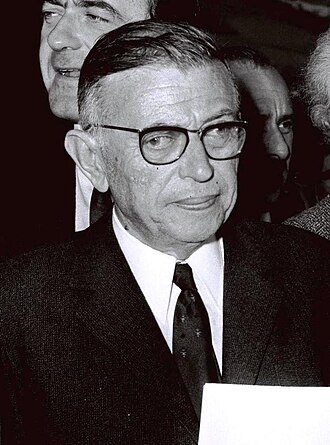
Jean-Paul Sartre
1905–1980 · French philosopher, novelist and playwright, a leading figure of existentialism and Marxism
Early years
Jean-Paul Charles Aymard Sartre was born in Paris on 21 June 1905, the only child of Jean-Baptiste Sartre, a French naval officer, and Anne-Marie Schweitzer. His father died of an illness, probably contracted in Indochina, when Sartre was two. His mother took him back to her parents' house in Meudon, where he was raised largely by her and by his maternal grandfather, Charles Schweitzer, a German teacher who taught him mathematics and introduced him to classical literature at an early age. Sartre was a cousin of the theologian, organist and physician Albert Schweitzer. When he was twelve his mother remarried and the family moved to La Rochelle, where he was often bullied, partly because of a wandering right eye.
Education
As a teenager in the 1920s he read Henri Bergson's essay on the immediate data of consciousness and became drawn to philosophy. He attended the Cours Hattemer in Paris and then the prestigious École Normale Supérieure, graduating in philosophy in 1929. There he met Raymond Aron, a friendship that was lasting and often strained, and Simone de Beauvoir, with whom he began a lifelong partnership that was open rather than monogamous. He was also one of the school's fiercest pranksters; in 1927 a media hoax he helped organize contributed to the resignation of the director, Gustave Lanson. His reading of Husserl, Heidegger and Hegel shaped these years, and in 1933–34 he studied phenomenology in Berlin, succeeding Aron at the French Institute there.
War and occupation
Mobilized in 1939 as a meteorologist in the French army, he was captured by German troops in 1940 and spent nine months as a prisoner of war, first in Nancy and then in a camp at Trier, where he wrote his first play, Bariona, or the Son of Thunder. During captivity he read Heidegger's Being and Time, which would strongly inform his own work on phenomenological ontology. Released in 1941 for health reasons, he returned to teaching in a Paris lycée and helped found the underground group Socialisme et Liberté alongside Beauvoir, Merleau-Ponty and others. The group dissolved without any significant action, and Sartre chose to write instead. Under the occupation he published Being and Nothingness, The Flies and No Exit, none of them censored by the Germans, and contributed to legal and clandestine periodicals. In his essays on occupied Paris he described how the apparent correctness of the Germans had drawn many French people into passive complicity, and how daily life became an abstract existence shaped by hunger and denunciation. He was an active contributor to Combat, the clandestine newspaper founded by Albert Camus, with whom he remained friendly until 1951.
Postwar years and Les Temps modernes
After the Liberation, Sartre settled on the rue Bonaparte, where he lived until 1962 and produced much of his later work. In 1945 he founded and edited the journal Les Temps modernes, which helped spread his ideas and political commitments. He gave up teaching to devote himself to writing and activism. Drawing on his wartime experience he composed the novel trilogy The Roads to Freedom, written between 1945 and 1949. In these years he also wrote on antisemitism in Reflections on the Jewish Question and on racism, most notably Black Orpheus, the introduction to Senghor's anthology of Black poetry, in which he criticized colonialism in light of his philosophy.
Cold War politics and anticolonialism
His second period, shaped by the Cold War, was marked by highly visible political involvement. He moved toward Marxism without joining the French Communist Party, defended the Soviet Union for years as a revolutionary state that could only be criticized for failing its own ideals, and offered strained justifications for Stalinist repression. This stance estranged him from Camus, whose The Rebel criticized communism and political violence. Sartre strongly supported the Algerian National Liberation Front, signed the Manifesto of the 121, and became a target of attacks by the OAS. He opposed the Vietnam War and took part in the Russell Tribunal. In 1960 he published the Critique of Dialectical Reason, an attempt to give Marxism a sturdier philosophical basis that concluded Marx's objective notion of class was flawed. Later he turned toward Maoism and the cause of Third World peoples, a shift whose consistency his critics questioned, among them Frank Gibney, who called him a "useful idiot."
Work and thought
The core of his philosophy is freedom and responsibility. Sartre argued that human beings are condemned to be free: they have no predetermined essence but make themselves through their acts, so that existence precedes essence. Hence his rejection of determinism and his notion of bad faith, the self-deception by which we avoid owning our freedom. In Being and Nothingness he distinguished the in-itself of things from the for-itself of consciousness, and in Existentialism Is a Humanism he set out his ideas in accessible form. As a novelist, Nausea (1938) is his best-known book, and The Roads to Freedom his major narrative cycle. As a playwright, No Exit contains the line "hell is other people." His major essay work was The Family Idiot, a vast study of Flaubert. With The Words (1964), an ironic autobiography of his childhood, he renounced literature understood as a bourgeois refuge.
Nobel Prize and refusal
In October 1964 he was awarded the Nobel Prize in Literature, which he declined. He explained that he did not wish to be transformed by an institution or to take sides in the cultural contest between East and West, and that he had always refused official honours. He was the first laureate to decline the prize voluntarily. In 1964 the Hebrew University of Jerusalem also offered him an honorary doctorate. Earlier, in 1945, he had refused the Legion of Honour.
Final years and death
In his last years his health declined, partly from the pace of his work and his use of amphetamines, and he became almost completely blind in 1973. He remained politically active, visited Red Army Faction members in prison, and near the end of his life described himself as a special kind of anarchist. He died in Paris on 15 April 1980, aged seventy-four, of pulmonary oedema. Tens of thousands of Parisians attended his funeral, and he was buried in the Montparnasse Cemetery, close to Beauvoir, whose grave lies beside his.
Key ideas
- Freedom and responsibility: human beings are free, and they answer for what they do with that freedom.
- Bad faith: the self-deception of denying one's own freedom by hiding behind roles or external labels.
- Existence precedes essence: there is no fixed human nature beforehand, and each person defines themselves through their actions.
- Commitment: philosophy and literature should be tied to political action and to responsibility towards others.
Curiosities
A prank at the Ecole Normale
With his classmates he told several newspapers that Charles Lindbergh was to receive an honorary degree from the school. Thousands turned up, unaware that it was a stunt involving a Lindbergh look-alike.
A diet of rabbits
During the occupation he lived mostly on rabbits sent by a friend of Beauvoir's. He reportedly threw one away because it had more maggots than meat.
A cinema lover from childhood
Sartre was a devoted filmgoer from childhood. In his autobiography The Words he describes cinemas as places of freedom where people of every social class met.
Teachers and influences
Influenced by
- Karl Marx 1818–1883
- Georg Wilhelm Friedrich Hegel 1770–1831
- Martin Heidegger 1889–1976
- Edmund Husserl 1859–1938
- Louis-Ferdinand Céline 1894–1961
- Emmanuel Levinas 1906–1995
Influenced
- Albert Camus 1913–1960
- Simone de Beauvoir 1908–1986
- Mario Vargas Llosa 1936–2025
- Kenzaburō Ōe 1935–2023
- Camilo José Cela 1916–2002
- Edward Said 1935–2003
- Julio Cortázar 1914–1984
- Gilles Deleuze 1925–1995
- Pierre Bourdieu 1930–2002
- Roland Barthes 1915–1980
- William S. Burroughs 1914–1997
- Frantz Fanon 1925–1961
- Boris Vian 1920–1959
- Emmanuel Levinas 1906–1995
- Bernard-Henri Lévy b. 1948
- Alain Badiou b. 1937
- R. D. Laing 1927–1989
- Fredric Jameson 1934–2024
- Walker Percy 1916–1990
- André Gorz 1923–2007
- Colin Wilson 1931–2013
- Pascal Bruckner b. 1948
- Arthur Coleman Danto 1924–2013
- Axel Honneth b. 1949
Original Filopedia text based on Wikipedia (es) and Wikipedia (en) and Wikidata.