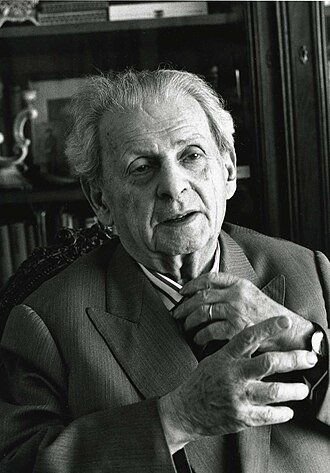
Emmanuel Levinas
1906–1995 · Lithuanian-French Jewish philosopher
Emmanuel Levinas (Kaunas, 1906 – Paris, 1995) was a philosopher of Lithuanian Jewish origin who worked mainly in France and became one of the central figures of twentieth-century ethical thought. He was trained in German phenomenology, but his work also engages Jewish philosophy, existentialism and ontology. He is best known for the claim that ethics is first philosophy.
Born into a traditional Jewish family, he spent his childhood in Kaunas and, during the First World War, in Kharkiv, where he lived through the Bolshevik revolution. He returned to Lithuania in 1920 and soon moved to France to study at Strasbourg, where he formed a lasting friendship with Maurice Blanchot. In 1928 he went to Freiburg to study with Husserl and met Heidegger, whose work impressed him deeply and from whom he later distanced himself because of Heidegger's closeness to Nazism. In 1930 he published his doctoral thesis on the theory of intuition in Husserl's phenomenology.
During the Second World War he served as an interpreter and was taken prisoner. He spent the rest of the war in a camp near Hanover, where his status as a French soldier spared him the treatment given to other Jewish prisoners. Meanwhile, most of his family in Lithuania were murdered. His wife and daughter survived with the help of Blanchot. The notes he kept in captivity led to De l'existence à l'existant (1947), where he questions Heidegger's ontology and argues that the anonymous being of existence can only be overcome through the ethical relation to the other.
In The Time and the Other, lectures that set out a relation to an otherness that cannot be possessed, he places time in the encounter with someone who escapes me. His major work, Totality and Infinity (1961), criticises Western philosophy for reducing the Other to the Same through knowledge and domination. In its place he proposes an ethics in which responsibility for the other comes before any objective search for truth. After the war he directed the Alliance Israélite Universelle and the École normale israélite orientale in Paris, and later taught at Poitiers, Nanterre and the Sorbonne.
His thought has shaped philosophy, theology and debates about responsibility toward others. His critique of totality remains a reference point for anyone seeking an alternative to a politics and a reason understood as mastery.
Key ideas
- Ethics as first philosophy: the relation to the other comes before knowledge and ontology, not the reverse.
- The face of the Other: the other appears as an alterity that cannot be reduced to an object or mastered by representation.
- Infinite responsibility: I have obligations toward the other that are not reciprocal, and their moral claim never runs out.
- Critique of totality: politics and ontology that reduce the other to the Same lead to war; against them he proposes the idea of infinity.
Works in Filopedia
Curiosities
A friend who saved his family
Maurice Blanchot helped his wife and daughter survive the war, first sheltering them in Paris and then hiding them in a monastery near Orléans.
A student who became a rabbi
Among his students at the Sorbonne was Rabbi Baruch Garzon, who later became one of the most important rabbis in the Spanish-speaking world.
Teachers and influences
Teachers
- Martin Heidegger 1889–1976
Influenced by
- Jean-Paul Sartre 1905–1980
- Martin Heidegger 1889–1976
Influenced
- Jean-Paul Sartre 1905–1980
- Jacques Derrida 1930–2004
- Bernard-Henri Lévy b. 1948
- Ivan Illich 1926–2002
- Alain Finkielkraut b. 1949
- Simon Critchley b. 1960
- Fabrice Hadjadj b. 1971
- Bracha L. Ettinger b. 1948
- François Laruelle 1937–2024
Original Filopedia text based on Wikipedia (es) and Wikipedia (en) and Wikidata.