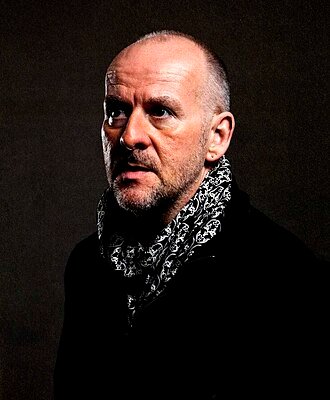
Simon Critchley
b. 1960 · British philosopher based in New York, specialist in ethics, politics and Continental thought
Simon Critchley (born 1960 in Letchworth, England) is a British philosopher who has spent much of his career in the United States. He is a leading figure in contemporary Continental philosophy, known for his engagement with Derrida, Levinas and Heidegger and for his commitment to bringing philosophy into public debate.
He studied literature at the University of Essex before turning to philosophy, and completed his doctorate in 1988. His thesis became The Ethics of Deconstruction (1992), which argues that Derrida's thought rests on an ethical experience shaped by Levinas. After teaching in Wales and Essex, and serving as Directeur de Programme at the Collège international de philosophie in Paris, he has taught at The New School in New York since 2004.
His output is wide-ranging. In Infinitely Demanding (2007) he argues that philosophy begins in political disappointment rather than wonder, and proposes an ethically grounded neo-anarchism. The Book of Dead Philosophers (2008) surveys the deaths and last words of around 190 thinkers. The Faith of the Faithless (2012) rethinks faith as a political concept without dismissing religion. His books on humour, Hamlet, Bowie and football show his interest in popular culture.
His influence reaches contemporary ethics and public philosophy, not least through his years moderating The Stone column in The New York Times.
Key ideas
- Philosophy born of disappointment: Critchley holds that philosophical thinking arises from political disillusion and from the gap between ethical demands and the real world.
- Ethics in dialogue with Levinas: on his reading, Derrida's deconstruction rests on an ethical experience shaped by Levinas's idea of alterity.
- Faith without dogmatic religion: he proposes rethinking faith as a political concept, neither dismissing religion nor leaving it to fundamentalists.
- Death as a philosophical theme: from Socrates to Montaigne, philosophy has been described as learning to die, and Critchley examines this idea through the lives of thinkers.
- Popular culture as philosophical material: humour, David Bowie's music or football give him a way to think about human experience philosophically.
Curiosities
A youth far from academia
According to his English biography, after deliberately failing his school exams he held various odd jobs and took part in the British punk scene, playing in bands that never took off.
A book about dead philosophers
The Book of Dead Philosophers catalogues the deaths and last words of around 190 philosophers, from the pre-Socratics to the twenty-first century.
Teachers and influences
Influenced by
- Emmanuel Levinas 1906–1995
- Alain Badiou b. 1937
Original Filopedia text based on Wikipedia (es) and Wikipedia (en) and Wikidata.