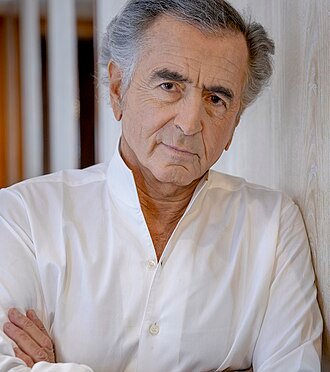
Bernard-Henri Lévy
b. 1948 · French philosopher and writer, a leading figure of the New Philosophers
Bernard-Henri Lévy (Béni Saf, French Algeria, 1948), known in France simply as BHL, is a French philosopher and writer. He became one of the best-known figures of the New Philosophers, a group of young intellectuals who, after the upheavals of May 1968, turned against the Marxist and socialist dogmas of the French left. He is also a journalist and documentary filmmaker, but his importance lies mainly in his moral and political thinking.
He was born into an affluent Sephardic Jewish family that moved to Paris a few months after his birth. He studied at the Lycée Louis-le-Grand and at the Institut d'Études Politiques, and later entered the prestigious École normale supérieure, where Jacques Derrida and Louis Althusser were among his teachers. In 1971 he became a war correspondent for the newspaper Combat, covering the Bangladesh Liberation War. That experience produced his first book, Bangla-Desh, Nationalism in the Revolution (1973), and it was prompted by a call from André Malraux for an international brigade to aid Bangladeshi separatists.
By the mid-1970s he had established himself as one of the voices of the New Philosophers alongside André Glucksmann and Alain Finkielkraut. His book The French Ideology (1981), which painted a bleak picture of French history, was criticised by Raymond Aron for its journalistic character and unbalanced approach. His detractors describe him as a media intellectual and a narcissist, while his supporters admire his commitment to freedom of thought.
His thinking centres on a critique of totalitarianism and of every form of barbarity, on the case for international intervention against mass atrocities, as in Bosnia and Darfur, and on reflection about Judaism. In The Genius of Judaism he argues that Jews have a particular role: to inform the world about truth and to oppose evil. In the late 1990s, together with Benny Lévy and Alain Finkielkraut, he founded an institute in Jerusalem dedicated to Levinasian studies, in honour of Emmanuel Levinas, whose ethical thought has remained a constant reference in his work.
Since 1993 he has chaired the supervisory board of the Franco-German television channel Arte. In 2011 he is credited with an important influence on President Nicolas Sarkozy's decision to support the Libyan rebels, although the extent of his role remains debated. His legacy is that of a public intellectual who has made controversy part of his presence, and his influence is measured as much in French debates about the left and political morality as in his work as a documentary filmmaker.
Key ideas
- Critique of the dogmas of the radical left: after 1968 he denounced dogmatic Marxism and socialism for their justifications of violence and oppression.
- Defence of freedom and human rights: his moral commitment aims to protect freedom of thought against every form of barbarity.
- Intervention against mass atrocities: he holds that atrocities must not be ignored, as his positions on Bosnia and Darfur show.
- Reflection on Judaism: in The Genius of Judaism he presents the Jewish people as bearers of a mission of truth against evil.
Works in Filopedia
- Left in Dark Times 2008
Curiosities
A call from Malraux
He was inspired by an appeal from André Malraux to form an international brigade supporting Bangladeshi separatists. That experience led him to become a war correspondent in 1971.
Too many houses
In 2017 he sold his house in Tangier, Morocco, for six million euros. He reportedly complained of owning too many homes.
Teachers and influences
Teachers
- Jacques Derrida 1930–2004
- Louis Althusser 1918–1990
Influenced by
- Jean-Paul Sartre 1905–1980
- Emmanuel Levinas 1906–1995
Original Filopedia text based on Wikipedia (es) and Wikipedia (en) and Wikidata.