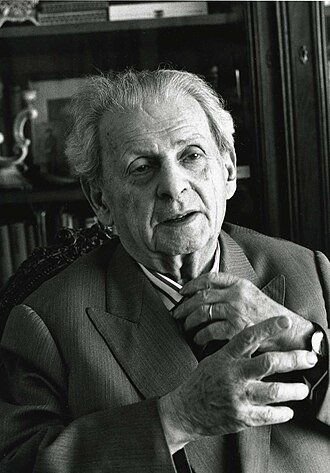
 AuthorEmmanuel Levinas1906–1995
Totality and Infinity: An Essay on Exteriority is a 1961 book on ethics by the philosopher Emmanuel Levinas. Strongly shaped by phenomenology, it is regarded as one of Levinas's most important works.
Its central thesis holds that all ethics derives from a confrontation with an other. This other, with whom we interact concretely, serves as a gateway into a more abstract Otherness. The distinction between totality and infinity separates the limited world, which contains the other as a material body, from a spiritual world. The subject gains access to this spiritual world, infinity, by opening itself to the Otherness of the other.
Levinas places heavy emphasis on the physical presence involved in meeting the other. Only a face-to-face encounter allows a true connection with infinity, owing to the incessant nature of this kind of interaction. Written words do not suffice, since by the time the subject perceives them they have already become past and have fallen into the register of totality. The book also contains observations on history and its judgement, such as the claim that the judgement of history is always pronounced by default.
The work is considered an original and significant contribution to philosophy, continental philosophy in particular, and can be read as a response to Levinas's teachers, Edmund Husserl and Martin Heidegger. The Stanford Encyclopedia of Philosophy and Britannica both identify it, along with Otherwise than Being (1974), as one of Levinas's most important works. Jacques Derrida criticized it in his essay "Violence and Metaphysics".
Themes
Original Filopedia text based on Wikipedia (en) and Wikidata.