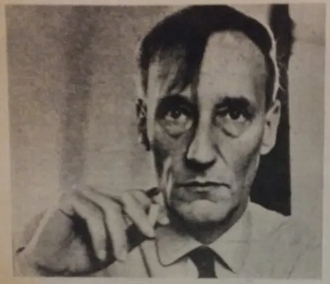
William S. Burroughs
1914–1997 · American novelist, essayist and visual artist
William Seward Burroughs (St. Louis, Missouri, 1914 – Lawrence, Kansas, 1997) was an American novelist, essayist and visual artist, and one of the central figures of the Beat Generation. Writing in English, he pushed narrative form to its limits, and his work, shaped by experimentation and by a long struggle with drug addiction, remains a key reference for anyone interested in postwar counterculture.
He was born into a wealthy St. Louis family. His grandfather had invented an adding machine that gave rise to a company later known as the Burroughs Corporation. He studied at Harvard, graduating in 1936, and later spent brief periods on anthropology and medicine, the latter in Vienna. From an early age he was drawn to men, a side of himself he kept hidden from his family for many years, and he developed a fascination with firearms that stayed with him throughout his life. During the Second World War he tried to enlist but was discharged on grounds of mental health. Afterwards he became dependent on morphine and then heroin, an addiction that shaped much of his life.
In New York he befriended Allen Ginsberg and Jack Kerouac, a circle that became the core of the Beat Generation. His first novel, Junkie, published in 1953 under the pen name William Lee, draws heavily on his own experience and pairs plain prose with subjects rarely treated so openly at the time. In 1951, in Mexico City, he killed his common-law wife, Joan Vollmer, in an accident he later described as a turning point in his writing. He was convicted of manslaughter in absentia and received a two-year suspended sentence. His third novel, Naked Lunch (1959), was the subject of one of the last literary censorship cases in the United States.
In the following decades he turned increasingly to experiment. Together with Brion Gysin he popularised the cut-up, a technique that breaks up the linear flow of text and recombines its fragments. It shaped the Nova trilogy, a mix of satire and science fiction built around the idea that language is a system of control to be dismantled. That conviction led him to see revolution as a matter of the mind rather than of society. Later, in the Red Night trilogy, which includes The Place of Dead Roads, he combined more conventional storytelling with the formal lessons of his experiments.
His influence reached far beyond literature, into punk, experimental rock, film and underground culture. His writing still reads as a sharp critique of postwar American society. He was elected to the American Academy and Institute of Arts and Letters in 1983, and his life has been adapted for the screen several times.
Key works
- Junkie (1953): an autobiographical account of heroin addiction, published under the pen name William Lee.
- Naked Lunch (1959): a fragmented, satirical novel written in Tangier that became a landmark of counterculture writing.
- Nova Express (1964): the first volume of the Nova trilogy, which makes intensive use of the cut-up technique.
- Cities of the Red Night (1981): the first book of the Red Night trilogy, with a more linear narrative and a magical tone.
- The Place of Dead Roads (1983): the second part of that trilogy, combining experiment and accessibility.
Where to start
Junkie 1953
Yonqui is the most accessible novel to begin with: it recounts, in the first person, Burroughs's addiction to heroin and morphine through William Lee, a stand-in for the author himself. It reads like a direct, almost documentary account of dependence, the marginal world around it, and the wandering life of the Beat generation.
Next: Naked Lunch. Naked Lunch takes the same experience of drugs into a fragmented, experimental register, and is the work that best shows the author's most radical style.
Works in Filopedia
- Junkie 1953
- Naked Lunch 1959
- Nova Express 1964
- Cities of the Red Night 1981
- The Place of Dead Roads 1983
Curiosities
A detour in family life
By his own account he left the Los Alamos Ranch School of his own accord, although a common version holds that he was expelled.
A name with a past
His grandfather invented an adding machine that gave rise to the family business, later known as the Burroughs Corporation.
Teachers and influences
Influenced by
- Jean-Paul Sartre 1905–1980
- Louis-Ferdinand Céline 1894–1961
Influenced
- Michel Foucault 1926–1984
- Jack Kerouac 1922–1969
- Gilles Deleuze 1925–1995
- Norman Mailer 1923–2007
- Ken Kesey 1935–2001
- Alan Moore b. 1953
- William Gibson b. 1948
- Irvine Welsh b. 1958
- Clive Barker b. 1952
- Michael Moorcock b. 1939
- Kathy Acker 1947–1997
- Neal Cassady 1926–1968
Original Filopedia text based on Wikipedia (es) and Wikipedia (en) and Wikidata.