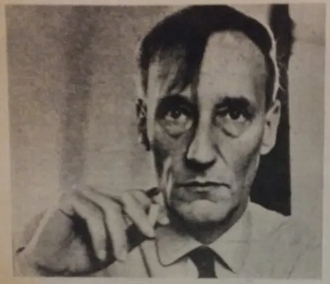
 AuthorWilliam S. Burroughs1914–1997
Nova Express is a novel published in 1964 by the American writer William S. Burroughs. It was written using the "fold-in" method, a version of the cut-up technique that Burroughs developed with Brion Gysin, which consists of folding and enfolding fragments of different texts into the narrative. It belongs to the so-called Nova Trilogy, or "Cut-Up Trilogy", together with The Soft Machine and The Ticket That Exploded. Burroughs regarded the trilogy as a sequel, or a "mathematical" continuation, of Naked Lunch.
At its core the book is a social critique of the control that machines and systems of power exercise over human life. Its central figures, the "Nova Mob" (Sammy the Butcher, Green Tony, Iron Claws, Jacky Blue Note and others), are presented as viruses that invade the human body and produce language; they stand for society, culture and government, which have seized control through word and image. Opposing them is the Nova Police, led by Inspector Lee, who fight on behalf of the rest of humanity. The work holds that language is the only instrument capable of resisting these mechanisms of domination, and that culture is the great control machine that must be dismantled.
Its reception was mixed. Where Naked Lunch had shocked the literary community, Nova Express is considered the close of Burroughs's stylistic experiment and of the trilogy. It was nominated for the Nebula Award for Best Novel in 1965 and is listed among David Pringle's 100 best science fiction novels (1985). Eric Mottram observed that although some sections grow tedious in their repetitions, the most powerful part of his work grows out of these obsessions. In 2014 Grove Press published a "Restored Text" edition edited by Oliver Harris, with corrections and extensive notes.
Themes
Other works by William S. Burroughs
- Junkie 1953
- Naked Lunch 1959
- Cities of the Red Night 1981
- The Place of Dead Roads 1983
Original Filopedia text based on Wikipedia (en) and Wikidata.