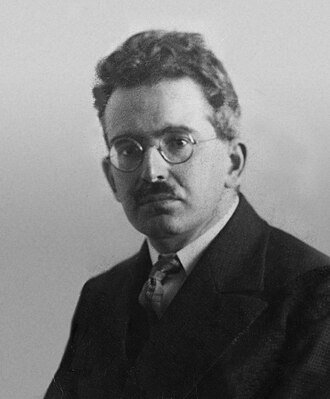
Walter Benjamin
1892–1940 · German philosopher, literary critic and essayist
Birth and family
Walter Benjamin was born in Berlin on 15 July 1892, into a wealthy and fully assimilated Ashkenazi Jewish family. His father, Emil Benjamin, had worked as a banker in Paris before moving to Germany, where he traded in antiques and art. His mother, Pauline Schönflies, told him stories that he later drew on when reflecting on the relationship between narration, tradition and present experience.
In poor health as a child, he was sent for two years in 1905 to a rural boarding school in Thuringia, part of Germany's country-school movement. He returned to Berlin in 1907 and resumed his studies at the Kaiser Friedrich School.
University years
In 1912 he enrolled at the University of Freiburg, but at the end of the summer semester he went back to Berlin to study philosophy there. It was in Berlin that he first encountered Zionism, which his liberal upbringing had not taught him. He never embraced religious orthodoxy or political Zionism; he developed instead what he called a kind of "cultural Zionism", a way of recognising and promoting Judaism and its ethics within European culture.
He was elected president of the Free Students' Association and wrote essays calling for educational and cultural reform, working alongside Gustav Wyneken's youth movement. When he was not re-elected, he returned to Freiburg and attended the lectures of Heinrich Rickert. In 1915 he moved to Munich, where he met Rainer Maria Rilke and Gershom Scholem, who became a lifelong friend. Their discussions about Judaism and Jewish mysticism inspired his 1916 essay on language.
The First World War and his doctorate
When war broke out in 1914 he tried to enlist, but the army turned him down. He later feigned illness to avoid conscription and took refuge in Switzerland, a choice that may have hurt his chances of an academic post after the war. He leaned towards the pacifism of the radical European left.
In 1917 he enrolled at the University of Bern, where he met Ernst Bloch and Dora Sophie Pollak, whom he married; their son, Stefan Rafael, was born in 1918. In 1919 he earned his doctorate summa cum laude with a dissertation on the concept of art criticism in German Romanticism. He then attempted a postdoctoral thesis on language, close in approach to the project Martin Heidegger was preparing on Duns Scotus. After Scholem informed him of this overlap, Benjamin seems to have developed a lasting antagonism towards Heidegger, whom he came to regard as a rival.
Early work and hardship
Back in Berlin, without the means to support his family, he lived with his parents. In 1921 he published the essay "Toward a Critique of Violence". During these years he translated Baudelaire and studied the origins of the German baroque mourning play, where he developed the concept of allegory and a messianic view of history. An attempt to found a journal failed, and his application for an academic teaching post was rejected because he was Jewish.
At this stage he moved towards materialism, though he never joined Zionism, communism or fascism. He was drawn to Proust and Baudelaire as observers of modern life. Around 1931 he experimented with hashish, inspired by Baudelaire's essay on the drug, and wrote about the gatherings where it was consumed.
Ibiza, Nice and exile
In 1932, during the crisis before Hitler came to power, he spent time on Ibiza, an island that moved him deeply and had a considerable influence on his life and work. After the Reichstag fire in February 1933 he grasped the gravity of the moment and even considered suicide. He settled in Nice and then in Paris, with stays at Bertolt Brecht's home in Svendborg and in San Remo, where his former wife Dora lived. He never returned to Berlin.
In Paris his finances were precarious, supported in part by the Institute for Social Research in Frankfurt under Max Horkheimer and Theodor Adorno, although his relations with them were intellectually strained; Horkheimer even reproached him for not being a good materialist. His correspondence with Adorno and Brecht was extensive, and he was also drawn into Georges Bataille's circle.
Final works and death
In these years he wrote the essays for which he is best known, among them "The Work of Art in the Age of Mechanical Reproduction" and the "Theses on the Philosophy of History", which attempt to bring together Marxism, Jewish mysticism and artistic avant-garde. His Parisian writings offer a new account of modernity.
After the Nazis occupied Paris he fled towards the Spanish border in 1940. He reached Portbou on 25 September, exhausted and ill, accompanied by other refugees. The next day he died in a local hotel after taking a lethal dose of morphine. Moved by his death, the Spanish authorities allowed his companions to continue their journey, by which they escaped the Third Reich.
Reception and legacy
He received little public recognition in his lifetime. His work spread after the war: his collected writings began to appear in 1955, and his international fame came largely through the English translations promoted by Hannah Arendt in 1968. Today he is a central figure in aesthetic theory, cultural criticism and Western Marxism, and his correspondence with Scholem remains a key source for understanding his thought.
Key ideas
- Aura: the unique presence of a work in time and space, which mechanical reproduction erodes.
- Allegory: a way of reading history through fragmentary remains, as opposed to a harmonious whole.
- History of the vanquished: a reading of the past that gives voice to those left out of the story of progress.
- Materialist messianism: the conviction that the past holds a possibility of redemption that political action must recognise.
Where to start
The Work of Art in the Age of Mechanical Reproduction 1936
It is Benjamin's most accessible text for a reader without specialized training. It analyzes how technical reproduction, such as photography and film, transforms the aura of the work of art and its social function. The reader will find clear ideas about the politics of aesthetics and mass culture.
Next: One-Way Street. Calle de sentido único offers brief prose meditations that display the author's fragmentary, aphoristic style, a light way to enter his thought.
Works in Filopedia
Curiosities
A famous uncle
His uncle William Stern was a prominent German child psychologist who developed the concept of the intelligence quotient (IQ).
An essay on hashish
In 1931 he experimented with hashish, inspired by Baudelaire's text on the drug, and wrote about a club where people gathered to take it.
A decisive escape
He crossed toward Spain guided by the anti-Nazi activist Lisa Fittko, who later described the journey in her book Escape Over the Pyrenees.
Teachers and influences
Influenced by
- Karl Marx 1818–1883
- Johann Wolfgang von Goethe 1749–1832
- Charles Baudelaire 1821–1867
- Bertolt Brecht 1898–1956
- Georg Lukács 1885–1971
- Ernst Bloch 1885–1977
- Gershom Scholem 1897–1982
Influenced
- Hannah Arendt 1906–1975
- Theodor W. Adorno 1903–1969
- Jacques Derrida 1930–2004
- Slavoj Žižek b. 1949
- Jean Baudrillard 1929–2007
- Giorgio Agamben b. 1942
- Fredric Jameson 1934–2024
- Byung-Chul Han b. 1959
- Juan Mayorga b. 1965
- Luigi Pareyson 1918–1991
Original Filopedia text based on Wikipedia (es) and Wikipedia (en) and Wikidata.