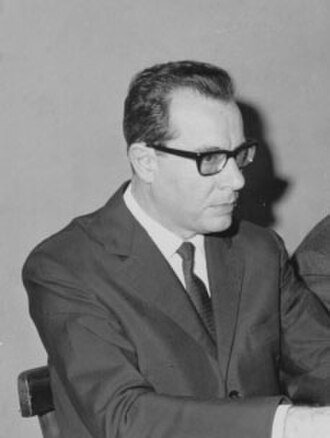
Luigi Pareyson
1918–1991 · Italian philosopher and theorist of hermeneutic aesthetics
Luigi Pareyson (Piasco, 1918 – Rapallo, 1991) was one of the leading Italian philosophers of the twentieth century. He studied at the University of Turin, graduating in 1939, and is best remembered for his hermeneutic aesthetics, which challenged the legacy of Benedetto Croce and gave rise to an influential school of thought in Italy.
After studying in Germany with Karl Jaspers, he taught philosophy at a secondary school in Cuneo and then at several universities, until he gained the chair of aesthetics at Turin in 1952. He also founded and edited the Rivista di estetica. His central work, Estetica. Teoria della formatività (1954), presents art as a form that invents its own rule while it is being made. The artwork is less a mere result than an achievement. Later, in Verità e interpretazione (1971), he applied this outlook to truth, understood as personal interpretation rather than objective fact.
Pareyson also wrote on evil, suffering and freedom, as his studies of Dostoevsky and his ontology of freedom, published posthumously, show. His influence reached the Turin School and pupils such as Gianni Vattimo.
Key ideas
- Formativity: art is an activity that discovers how to be made while it is being made, without fixed rules set in advance.
- Truth as interpretation: truth is not an objective datum as in science, but a personal interpretation that demands responsibility.
- Ontological personalism: his name for a position that places the person at the centre of understanding being.
- Reading of Schelling: for him, Schelling's late thought was the precursor of existentialism.
- The problem of evil: human suffering and freedom are central axes of his philosophical and religious reflection.
Teachers and influences
Pupils
- Gianni Vattimo 1936–2023
Influenced by
- Martin Heidegger 1889–1976
- Jacques Derrida 1930–2004
- Walter Benjamin 1892–1940
- Karl Jaspers 1883–1969
Influenced
- Gianni Vattimo 1936–2023
Original Filopedia text based on Wikipedia (es) and Wikipedia (en) and Wikidata.