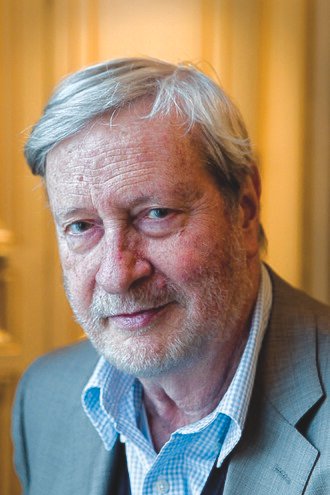
Gianni Vattimo
1936–2023 · Italian postmodern philosopher, founder of weak thought
Gianni Vattimo (born Gianteresio Vattimo in Turin in 1936, died in Rivoli in 2023) was an Italian philosopher best known for weak thought, a term he coined. He is usually placed within postmodern philosophy. He also spent years in politics, but his lasting reputation rests on his thinking.
Raised as a Catholic, he joined Catholic Action as a young man and worked for Italian public radio. He studied philosophy at the University of Turin under Luigi Pareyson, graduating in 1959. With a scholarship he then went to Heidelberg, where he worked with Karl Löwith, Jürgen Habermas and Hans-Georg Gadamer. He returned to Turin in 1964, becoming professor of aesthetics in 1969 and of theoretical philosophy in 1982. He also taught as a visiting professor at several American universities and received honorary degrees in Latin America and Spain.
Vattimo questioned the classical metaphysics and the firm foundations of modernity. Following Heidegger, he treated truth less as a fixed structure than as an opening of horizons. From Nietzsche he took the idea that values and metaphysical structures are games of forces, and he argued that hermeneutics must accept its nihilistic vocation. History appears as a gradual weakening of structures, which can lead to a choice for non-violence. This led to weak thought, a philosophy that gives up absolute certainties and favours tolerance and diversity.
In the 2000s he moved towards Marxism, proposing a communism freed from Soviet distortions, which he called hermeneutic communism. His later writings also turned to religion, with a critical stance towards the Church and sympathy for a non-religious Christianity. His influence is felt in debates on postmodernity, hermeneutics and the relation between philosophy and religion.
Key ideas
- Weak thought: in place of strong truths and metaphysical foundations, a philosophy that accepts the loss of absolute certainties.
- Nihilistic hermeneutics: interpretation does not describe permanent structures of reality, and its destiny is to accept the dissolution of foundations.
- Verwindung: overcoming modernity means a twisted, radical recovery of its premises rather than a clean break.
- Postmodernity and tolerance: the end of grand narratives opens the way to diversity and an ethics of non-violence.
- Post-metaphysical religion: he proposes a non-religious Christianity, critical of the Church yet indebted to its tradition.
Teachers and influences
Teachers
- Hans-Georg Gadamer 1900–2002
- Luigi Pareyson 1918–1991
Pupils
- Alessandro Baricco b. 1958
- Maurizio Ferraris b. 1956
Influenced by
- Luigi Pareyson 1918–1991
Original Filopedia text based on Wikipedia (es) and Wikipedia (en) and Wikidata.