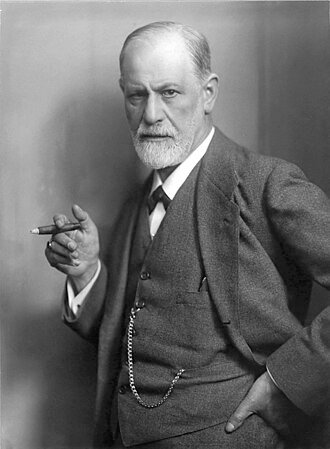
Sigmund Freud
1856–1939 · Austrian neurologist and founder of psychoanalysis
Early life and education
Sigismund Schlomo Freud was born on 6 May 1856 in Freiberg, in the Moravian region of the Austrian Empire (today Příbor, in the Czech Republic), into a Jewish family. His father, Jacob Freud, was a wool merchant who had two sons from an earlier marriage; his mother, Amalia Nathansohn, was twenty years younger than him. Sigmund was the eldest of eight children. When the family's business prospects faded, they moved first to Leipzig and in 1860 to Vienna, settling in the Jewish district of Leopoldstadt. Raised without religion and later describing himself as an unbeliever, Freud nevertheless always identified with Jewish culture.
He entered a demanding Viennese secondary school in 1865, graduated with honours in 1873, and that same year began studies at the University of Vienna, initially intending to read law before turning to medicine. His studies included philosophy under Franz Brentano, physiology under Ernst Brücke, and zoology under Carl Claus. He spent several years in Brücke's laboratory examining the nervous systems of vertebrates and invertebrates, work that later proved relevant to the study of the neuron. He qualified as a doctor in March 1881.
Neurology and early research
Between 1882 and 1885 he worked at the Vienna General Hospital in several departments, most importantly in Theodor Meynert's psychiatric clinic, which deepened his interest in clinical work. His research on cocaine brought him some attention: in 1884 he published on its palliative effects and suggested its use as a local anaesthetic, although Carl Koller received the recognition for applying it successfully in eye surgery. Freud also studied aphasia, which formed the basis of his first book on the subject, published in 1891. Later letters reveal that he tried to treat his friend Ernst von Fleischl-Marxow, who was addicted to morphine, with cocaine, with disastrous results.
In 1885 he won a fellowship to study in Paris with Jean-Martin Charcot, whose work on hysteria and hypnosis impressed him deeply and turned his attention towards psychopathology. Back in Vienna in 1886, he opened a private practice specialising in nervous disorders and married Martha Bernays, with whom he had six children, among them Anna, who would become a leading psychoanalyst.
From hypnosis to free association
At first Freud used hypnosis and the cathartic method that his older colleague and friend Josef Breuer had employed with a patient known as Anna O. His results were inconsistent, however, and he gradually abandoned hypnosis and suggestion in favour of free association, encouraging patients to say whatever came to mind without censorship. He found that dreams could be analysed to reveal unconscious contents and the mechanisms of repression that, in his view, underlay symptoms.
By around 1896 he was using the term psychoanalysis for both his method and the theory behind it. This was a period of personal turmoil, marked by his father's death in 1896, and he carried out a self-analysis of his own dreams and childhood memories. From this came an important revision of his early theory: he abandoned the idea that all neuroses stemmed from real sexual abuse in childhood and argued that infantile fantasies, whether real or imagined, played a causal role. This shift led to his formulation of the Oedipus complex.
The Interpretation of Dreams and the spread of his ideas
In 1899 he published The Interpretation of Dreams, which he regarded as his most important work. In it he argues that dreams are disguised fulfilments of repressed wishes and sets out a model of the mind with unconscious, preconscious and conscious levels. Books such as The Psychopathology of Everyday Life (1901) and Jokes and Their Relation to the Unconscious (1905) carried these ideas beyond the consulting room, while the Three Essays on the Theory of Sexuality (1905) developed his account of infantile sexuality and its oral, anal and phallic phases.
For years he remained an isolated and criticised figure, but a circle of followers slowly formed around him. In 1902 he finally obtained the title of professor extraordinarius at the University of Vienna, an honour he remarked upon with some irony. That same year he began meeting weekly with a group of physicians in what he called the Wednesday Psychological Society, the seed of the psychoanalytic movement. In 1909 he travelled to the United States, where he gave five lectures at Clark University and received an honorary doctorate, accompanied by Jung and Ferenczi.
Dissent and the consolidation of the movement
The movement was shaped by breaks with former allies. Alfred Adler left in 1911 to found individual psychology, and Carl Gustav Jung distanced himself in 1914 to develop analytical psychology, after disagreements about the libido and the collective unconscious. Otto Rank also withdrew in 1926. To protect doctrinal coherence, Freud and some close colleagues formed a secret committee of loyalists in 1912. Institutionally, journals, societies and an International Psychoanalytical Association were established, with centres in Berlin, London, Budapest, New York and other cities.
In 1930 he received the Goethe Prize from the city of Frankfurt in recognition of his contribution to German culture. His work was admired by writers such as Thomas Mann, who gave an address in his honour on his eightieth birthday, although he never received the Nobel Prize despite several nominations. Among his mature works are Totem and Taboo (1913), Beyond the Pleasure Principle (1920), in which he introduces the death drive, The Ego and the Id (1923), which proposes the tripartite model of the mind, and Civilization and Its Discontents (1930).
Illness and exile
Freud smoked cigars for much of his life. In 1923 he was diagnosed with cancer of the palate, and over the following years he underwent numerous operations. The illness caused him great suffering and required prostheses that made speech difficult. He nonetheless continued writing and seeing patients almost to the end.
After Nazi Germany annexed Austria in 1938, Freud, a Jew and the founder of a discipline the regime regarded with hostility, saw his books burned in public. His daughter Anna was interrogated by the Gestapo, and several family members suffered persecution. Thanks to the intervention of Marie Bonaparte and Ernest Jones, and despite protracted negotiations with the Nazi authorities, he left Vienna in June 1938 and settled in London, in a house on Maresfield Gardens. His four sisters who remained in Vienna were murdered in concentration camps.
On 23 September 1939, weakened by illness, he asked his personal physician, Max Schur, to keep his promise to end his suffering. He died after several doses of morphine. His ashes rest at the Golders Green crematorium, beside those of Martha.
Reception and legacy
Freud remains a controversial figure. Some regard him as a great scientist who uncovered much of the workings of the human mind; others see a thinker who transformed our understanding of human nature and helped break taboos, but whose theories do not withstand rigorous scientific scrutiny. Critics question the empirical basis of psychoanalysis, his account of female sexuality, and the universality of his schemes, which anthropology and sociology have considered ethnocentric.
His influence is nonetheless undeniable. Concepts such as the unconscious, repression, the Oedipus complex and the Freudian slip are part of everyday language. The Frankfurt School, Freudian Marxism, surrealism and much literary and film criticism draw on his ideas, and his therapeutic method gave rise to many schools of psychotherapy. Freud left a lasting imprint on contemporary thought, even where many of his claims have since been revised or rejected.
Key ideas
- The unconscious: a large part of mental life lies beyond awareness and shows itself in dreams, slips of the tongue and symptoms.
- Free association: a method in which the patient says without censorship whatever comes to mind, in order to uncover hidden conflicts.
- Dreams as wish fulfilment: dreams are disguised scenes that allow repressed desires to be interpreted.
- Infantile sexuality: psychic development passes through stages in which sexual drive, understood in a broad sense, plays a central role.
- Tripartite model of the psyche: the mind is organised into id, ego and superego, instances that often pull against one another.
Where to start
The Interpretation of Dreams 1900
The Interpretation of Dreams is the work in which Freud first systematically set out his theory of the unconscious based on the analysis of dreams. It is central to understanding the starting point of psychoanalysis and offers concrete examples of analysis that a reader can follow without prior training.
Next: Three Essays on the Theory of Sexuality. Three Essays on the Theory of Sexuality develops Freud's conception of sexuality and childhood, expanding the ideas about the unconscious that emerge from the book on dreams.
Works in Filopedia
Books to read
- Die Traumdeutung GermanEPUB 708 KBRead online
- A General Introduction to Psychoanalysis EnglishEPUB 423 KBRead online
- Dream Psychology: Psychoanalysis for Beginners EnglishEPUB 186 KBRead online
- Das Unheimliche GermanEPUB 105 KBRead online
- Drei Abhandlungen zur Sexualtheorie GermanEPUB 161 KBRead online
- Totem und Tabu Einige Übereinstimmungen im Seelenleben der Wilden und der Neurotiker GermanEPUB 231 KBRead online
- Massenpsychologie und Ich-Analyse GermanEPUB 142 KBRead online
- Jenseits des Lustprinzips GermanEPUB 131 KBRead online
- On dreams EnglishEPUB 177 KBRead online
- Eine Schwierigkeit der Psychoanalyse GermanEPUB 70 KBRead online
- Zur Psychopathologie des Alltagslebens Über Vergessen, Versprechen, Vergreifen, Aberglaube und Irrtum GermanEPUB 163 KBRead online
- Die infantile Wiederkehr des Totemismus Über einige Übereinstimmungen im Seelenleben der Wilden und der Neurotiker IV GermanEPUB 95 KBRead online
- Über Psychoanalyse: Fünf Vorlesungen GermanEPUB 115 KBRead online
- Das Tabu und die Ambivalenz der Gefühlsregungen Über einige Übereinstimmungen im Seelenleben der Wilden und der Neurotiker II GermanEPUB 86 KBRead online
- Zeitgemäßes über Krieg und Tod GermanEPUB 99 KBRead online
Curiosities
A secret academy
Freud and his friend Eduard Silberstein taught themselves Spanish and formed a kind of secret society they called the Academia Castellana. They used as pseudonyms the names of the two dogs from Cervantes' The Colloquy of the Dogs.
A cocaine experiment
According to letters later published, Freud tried to treat his friend Ernst von Fleischl-Marxow, who was addicted to morphine, with cocaine. The treatment only added a new addiction, and Freud never publicly acknowledged the failure.
A crater named after him
A small impact crater on the Moon, on a plateau within Oceanus Procellarum on the near side, was named Freud in his honour.
Teachers and influences
Teachers
- Jean-Martin Charcot 1825–1893
- Theodor Meynert 1833–1892
- Ambroise-Auguste Liébeault 1823–1904
Pupils
- Alfred Adler 1870–1937
- Lou Andreas-Salomem 1861–1937
- Hanns Sachs 1881–1947
Influenced
- Michel Foucault 1926–1984
- Stefan Zweig 1881–1942
- Erich Fromm 1900–1980
- Jürgen Habermas 1929–2026
- Jacques Derrida 1930–2004
- Slavoj Žižek b. 1949
- Gilles Deleuze 1925–1995
- Jordan Peterson b. 1962
- Jacques Lacan 1901–1981
- Viktor Frankl 1905–1997
- Julia Kristeva b. 1941
- Georges Bataille 1897–1962
- Lou Andreas-Salomem 1861–1937
- Melanie Klein 1882–1960
- Hermann Rorschach 1884–1922
- Hélène Cixous b. 1937
- Eugen Bleuler 1857–1939
- Eric Berne 1910–1970
- Sándor Ferenczi 1873–1933
- Jean-Luc Nancy 1940–2021
- Edmund Wilson 1895–1972
- Otto Gross 1877–1920
- Erich Neumann 1905–1960
- Bernard Stiegler 1952–2020
Original Filopedia text based on Wikipedia (es) and Wikipedia (en) and Wikidata.