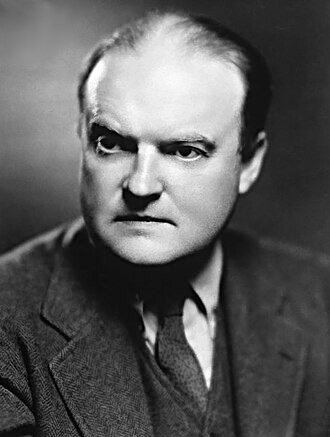
Edmund Wilson
1895–1972 · American literary critic and essayist
Edmund Wilson (Red Bank, New Jersey, 1895 – Talcottville, New York, 1972) was one of the most influential literary critics of the twentieth century in the United States. He wrote about literature, history, politics and modern culture in a clear prose driven by a curiosity that went well beyond strict literary criticism. His work helped American readers discover and appreciate novelists such as Hemingway, Dos Passos, Faulkner, Fitzgerald and Nabokov.
He studied at The Hill School and at Princeton University, where he befriended Fitzgerald. He began as a reporter for the New York Sun and served in the army during the First World War. He then edited Vanity Fair in 1920 and 1921 and for years contributed to The New Republic and The New Yorker. His breakthrough as a critic came with Axel's Castle (1931), a survey of Symbolism and of writers such as Rimbaud, Yeats, Valéry, Eliot, Proust, Joyce and Stein. Wilson did not confine himself to literature: in To the Finland Station (1940) he traced European socialism from Michelet's rediscovery of Vico to Lenin's arrival in Petrograd in 1917. His early work owes much to Marx and Freud.
He also wrote novels, short stories and poetry, but his main contribution was criticism. His personal life was turbulent, marked by several marriages, including the one to Mary McCarthy, and by a long friendship with Nabokov that eventually soured. During the Cold War he clashed with the government over his refusal to pay income taxes, and he criticized the arms race and the Vietnam War.
His legacy is twofold. His essays shaped how American modern literature was read, and he championed a canon of national classics; after his death this effort materialized in The Library of America.
Key works
- Axel's Castle (1931), a study of modern literature and Symbolism.
- To the Finland Station (1940), a history of European socialist thought up to the Russian Revolution.
- Memoirs of Hecate County (1946), a collection of short stories.
- Patriotic Gore (1962), a study of the literature of the American Civil War.
- The Cold War and the Income Tax: A Protest (1963), an essay against the arms race and the erosion of civil liberties.
Works in Filopedia
Curiosities
A presidential honour
John F. Kennedy selected him for the Presidential Medal of Freedom. Lyndon Johnson awarded it to him in absentia in 1963, although Wilson held a very low opinion of Johnson.
Editing Fitzgerald after his death
After Fitzgerald died in 1940, Wilson edited two of his books for posthumous publication, including *The Last Tycoon*.
Teachers and influences
Influenced by
- Karl Marx 1818–1883
- Sigmund Freud 1856–1939
- James Joyce 1882–1941
- Marcel Proust 1871–1922
- T. S. Eliot 1888–1965
- William Butler Yeats 1865–1939
- Arthur Rimbaud 1854–1891
- Paul Valéry 1871–1945
- Gertrude Stein 1874–1946
- Evelyn Waugh 1903–1966
Original Filopedia text based on Wikipedia (es) and Wikipedia (en) and Wikidata.