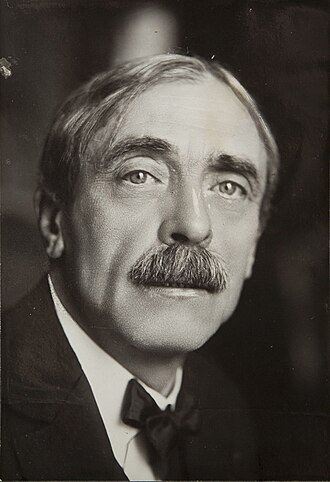
Paul Valéry
1871–1945 · French poet, essayist and thinker, a leading figure of pure poetry
Origins and Education
Ambroise-Paul-Toussaint-Jules Valéry was born in Sète, a town on the Mediterranean coast of the Hérault, to a Corsican father and a Genoese mother of Istrian descent. He was raised, however, in Montpellier, a larger urban centre nearby. After a traditional Catholic education he studied law at university. His inclination toward writing emerged early, although his first publications date from his twenties.
Paris and the Circle of Mallarmé
He lived in Paris for most of his life and for a time belonged to the circle of Stéphane Mallarmé, whose influence shaped his understanding of poetry. In 1900 he married Jeannine Gobillard, a friend of the Mallarmé family and a niece of the painter Berthe Morisot. The wedding was a double ceremony, since the bride's cousin Julie Manet married the painter Ernest Rouart at the same event. The couple had three children: Claude, Agathe and François.
The Great Silence and the Return to Poetry
After an existential crisis in 1892 and the death of Mallarmé, Valéry all but stopped writing around 1898 and published almost nothing for nearly twenty years. In 1913 André Gide, who was founding the Nouvelle Revue Française, asked permission to publish verses that had appeared earlier in various journals. Valéry refused, but his friends gathered those issues, had them typed and presented them to him. After some hesitation he agreed to revise them and decided to complete the collection with a new poem, which he also regarded as his farewell to poetry. The war delayed the work, and in 1917 he finally published La Jeune Parque, which made him famous.
Fame and Honours
In 1920 he published Le Cimetière marin, and in 1922 Charmes appeared in a reduced edition that gathered his poetry. A survey of 1921 named him the greatest French poet of his time. In 1925 he was elected to the Académie française. From then on his public roles multiplied: he worked on cultural questions for the League of Nations, founded the Collège International de Cannes in 1931 to teach French language and civilisation, and delivered the keynote address at the 1932 German centenary of Goethe's death. He was also the inaugural holder of the Chair of Poetics at the Collège de France and, in 1937, was appointed head of what later became the University of Nice.
Occupation and Final Years
During the Second World War the Vichy regime removed him from some of these posts because of his quiet refusal to collaborate with Vichy or the German occupation. In the Academy he delivered the funeral eulogy for Henri Bergson, who was of Jewish origin, and in 1942 he joined the National Committee of Writers, linked to the resistance. He was nominated for the Nobel Prize in Literature twelve times, and it is believed the Swedish Academy meant to award it to him in 1945. He died in Paris in July of that year and was buried in Sète, in the cemetery that appears in his most famous poem.
Prose and Thought
Valéry considered his true work to be his prose. He wrote dialogues, essays and aphorisms on art, history, letters, music and current affairs, many gathered in the series Variétés. His character Monsieur Teste embodies the ideal of a mind in full command of itself, subjected to relentless discipline. His writings show a sceptical view of human nature and a broadly liberal view of state power, and he argued that the mixing of peoples was a condition of progress against the myths of racial purity.
The Notebooks
Perhaps his most striking achievement was the intellectual diary he called the Cahiers, more than two hundred notebooks in which he recorded reflections over nearly fifty years. Each morning he devoted time to them, saying that this earned him the right to be stupid for the rest of the day. Many entries deal with science and mathematics, to which he gave more time than to poetry, and they contain drafts of aphorisms he later used in his books. For decades they received little scholarly attention, and only since 1980 have they been studied systematically.
Legacy
Valéry is regarded as the leading representative of pure poetry, and his influence reaches later criticism and poetry. His prose has been discussed by writers such as Theodor Adorno, Octavio Paz and Jacques Derrida. His intellectual lyricism inspired poets such as James Merrill and Edgar Bowers, and his figure remains associated with the ideal of a rigorous intelligence aware of itself.
Key ideas
- Pure poetry: a poem should seek its music and form before anecdote or immediate emotion.
- Self-consciousness: in La Jeune Parque, the speaker is both object and conscious observer of herself through a single night.
- The ideal of the wise man: in Monsieur Teste, precision of thought and command of one's own mind are pushed to a point where weariness appears.
- Scepticism towards grand narratives: Valéry distrusts sweeping claims about human nature and sees mixture and diversity as engines of cultural progress.
Books to read
- Charmes FrenchEPUB 148 KBRead online
Curiosities
A long silence
After a personal crisis in 1892 and Mallarmé's death, he published almost no verse for nearly twenty years. His return in 1917 with La Jeune Parque made him famous at once.
A morning for thinking
He devoted the early hours of each day to his Cahiers, and he joked that this earned him the right to be stupid for the rest of the day.
A Nobel candidate
He was nominated for the Nobel Prize in Literature twelve times, and it is believed the Swedish Academy intended to award it to him in 1945, the year he died.
Teachers and influences
Influenced
- Albert Einstein 1879–1955
- T. S. Eliot 1888–1965
- Edmund Wilson 1895–1972
- Bernard Stiegler 1952–2020
Original Filopedia text based on Wikipedia (es) and Wikipedia (en) and Wikidata.