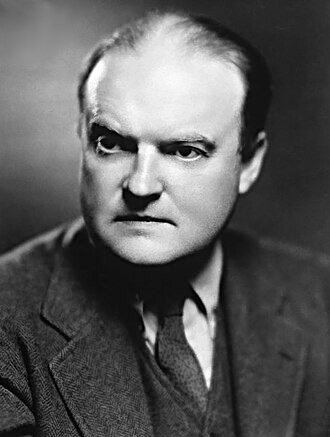
 AuthorEdmund Wilson1895–1972
To the Finland Station is a book by the American literary critic Edmund Wilson, published in 1940 by Harcourt, Brace & Co. Its subtitle, "A Study in the Writing and Acting of History", states its aim: to trace the history of revolutionary thought and the birth of socialism. The book begins with the French Revolution and moves through the collaboration of Karl Marx and Friedrich Engels to its namesake event, the arrival of Vladimir Lenin at the Finland Station in Petrograd in April 1917, returning from exile in Switzerland. The episode is often regarded as a critical step toward the October Revolution.
The book is divided into three sections. The first devotes much of its space to Jules Michelet and then considers the decline of the revolutionary tradition through Ernest Renan, Hippolyte Taine and Anatole France. The second, the longest, covers socialism and communism: first their origins, with Babeuf, Saint-Simon, Fourier, Owen and Enfantin, and then Marx's work, his partnership with Engels, and the disputes they faced from Lassalle and Bakunin. The third section focuses on Lenin and Trotsky, with attention to writings such as What Is to Be Done? and Trotsky's history of the Russian Revolution.
The book's reception was mixed. It appeared at an unfavourable moment, just after Trotsky's assassination in Mexico, when many Western intellectuals were turning away from Communism. Over time it found more readers, especially after the 1953 paperback edition, and in 1972 Wilson revisited it in a new introduction that qualified his view of Soviet Communism. Today it is remembered as a work of great narrative and intellectual ambition, though critics have pointed to excesses in its portrait of Lenin.
Themes
Original Filopedia text based on Wikipedia (en) and Wikidata.