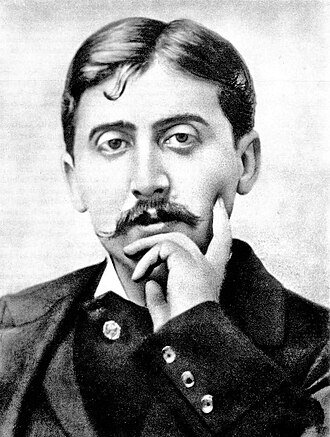
Marcel Proust
1871–1922 · French novelist, critic and essayist
Childhood and family
Valentin Louis Georges Eugène Marcel Proust was born on 10 July 1871 in Paris, in the Auteuil quarter, at the home of a great-uncle. He came into the world two months after the Treaty of Frankfurt formally ended the Franco-Prussian War, and his childhood coincided with the consolidation of the French Third Republic. His father, Adrien Proust, was a prominent pathologist and epidemiologist who had studied cholera in Europe and Asia and later became a leading figure in the Paris medical faculty. His mother, Jeanne Clémence Weil, came from a prosperous Alsatian Jewish family; she was well-read, had a lively sense of humour and a command of English good enough to help her son with his later translations of Ruskin. Proust was raised in his father's Catholic faith and was baptised and confirmed, though he never practised formally; he later described himself as an atheist with something of a mystic's temperament. His younger brother Robert, born in 1873, took up medicine and became a successful surgeon, which spared Marcel the family pressure to follow a profession.
Illness and the summers at Illiers
At the age of nine he suffered his first serious asthma attack, after a walk in the Bois de Boulogne, and his father feared he had died before he recovered. From then on he was regarded as a sickly child, and ill health stayed with him for life. He spent long holidays in Illiers, his father's village about twenty-five kilometres from Chartres, at the house of relatives. That place, together with memories of the Auteuil house, served as the model for Combray, the setting of some of the most important scenes in his novel. The village was renamed Illiers-Combray in 1971 for the Proust centenary. After the childhood attack these visits were stopped, and Proust came to see Illiers as a lost paradise.
Lycée and early society life
In 1882 he entered the Lycée Condorcet, where his attendance was irregular because of illness. Even so he excelled in literature, knew Victor Hugo and Alfred de Musset almost by heart, and did well in philosophy under Alphonse Darlu. His friends included Jacques Bizet, son of the composer of Carmen, Fernand Gregh and Daniel Halévy, with whom he contributed to school literary magazines. His first love was Marie de Bénardaky, a playmate in the Champs-Élysées. From about 1888 he began attending Parisian salons frequented by the upper bourgeoisie, artists and writers, where his charm and conversation earned him a reputation as a snob and a dilettante that would follow him for years. His first documented homosexual relationship was with Lucien Daudet, son of the novelist Alphonse Daudet, in an era when the same-sex conduct was prosecuted, as the imprisonment of Oscar Wilde in 1895 shows.
Military service, studies and his first book
In 1889 he enlisted voluntarily for military service, partly to be among other young men and partly to shorten his obligatory term. He later called it one of the most pleasant experiences of his life, although he was ranked 63rd of 64 at the end. Afterwards he wished to re-enlist, but his health prevented it. To please his father he studied law and qualified as a lawyer, though he never practised; he then took a degree in letters, completed in 1895, studying with teachers such as Albert Sorel and Henri Bergson, whose ideas about time would shape his work. In 1896 he published Les plaisirs et les jours, a miscellany of prose poems, portraits and tales in a decadent style, with a preface by Anatole France and illustrations by Madeleine Lemaire. It passed largely unnoticed, and a savage review by Jean Lorrain, which hinted at Proust's relationship with Lucien Daudet, led to a duel that ended without serious injury. In these years his friends Gaston Arman de Caillavet and Jeanne Pouquet, whose home he frequented, provided the models for characters such as Saint-Loup and Gilberte.
Ruskin, the Dreyfus affair and the translations
In 1893 he met the aristocratic poet Robert de Montesquiou, who introduced him to aristocratic drawing rooms between 1894 and 1900, providing material he later used in his novel. He was also among the earliest supporters of Dreyfus: he circulated a petition for the captain, wrongly convicted of treason, and persuaded Anatole France to sign it. After John Ruskin's death in 1900 he began translating the English writer's work into French, with his mother preparing an initial literal draft which he then polished. He produced The Bible of Amiens in 1904, with a long introduction, and Sesame and Lilies in 1906. The prefaces were well received, and Henri Bergson praised the study of Ruskin, although the translations were a commercial failure. Proust gradually distanced himself from some of Ruskin's aesthetic positions.
His mother's death and the writing of the great work
The death of his father in 1903 and, above all, that of his mother in September 1905 were decisive blows. His health declined through asthma and depression, and he retreated to an apartment on the boulevard Haussmann, where he lined the walls with cork to block out noise and devoted himself to writing. He worked at night, ate little and drank large quantities of coffee; he constantly revised and added inserts that his housekeeper Céleste Albaret glued into the pages. He began the work around 1907, initially envisaging a critique of Sainte-Beuve, and it soon grew into À la recherche du temps perdu. The first part, Swann's Way, was rejected by the Nouvelle Revue Française; the editor responsible, André Gide, later admitted the mistake and called it one of the most serious errors of his life. The book finally appeared in November 1913 at the author's own expense.
The war and recognition
The First World War delayed the publication of the sequels. Proust, who was declared unfit for service, helped in whatever ways he could from home, while his brother rose to captain and several friends died at the front; meanwhile he devoted himself to rewriting, which made the novel longer. He frequented the Ritz hotel, earning the nickname «Proust of the Ritz». After the war came À l'ombre des jeunes filles en fleurs, now accepted by the NRF after Gide's apology, and in 1919 it won the Prix Goncourt, not without controversy. This was his first notable recognition, three years before his death.
Final years and legacy
His last years were dominated by illness. He went out for the last time in October 1922 and, shortly after contracting pneumonia, died on 18 November 1922 at the age of fifty-one. He was buried in the Père-Lachaise Cemetery beside his father and brother. Robert Proust oversaw the posthumous publication of the remaining volumes: The Prisoner (1923), The Fugitive (1925) and Time Regained (1927). His correspondence, comprising more than a hundred thousand letters, was gathered into twenty-one volumes by 1993. His style, shaped by impressionism and symbolism, is marked by minute description, slow rhythm, long periodic sentences and indirect interior monologue that renders reality as a stream of consciousness. The novel deals with time, memory, art, love and jealousy, and homosexuality, and its influence on twentieth-century fiction has been profound.
Key works
- In Search of Lost Time (1913-1927): a seven-part novel that follows a narrator's memories from childhood into maturity.
- Swann's Way (1913): the first part of the great novel, which contains the madeleine scene.
- In the Shadow of Young Girls in Flower (1919): the second part, which won the Prix Goncourt.
- Pleasures and Regrets (1896): a miscellany of early stories and short pieces.
- Jean Santeuil (published 1952): an unfinished posthumous novel that predates his major work.
Where to start
In Search of Lost Time is Proust's central work and the most complete starting point. Narrated from memory, it portrays the social life of the French upper bourgeoisie and aristocracy, the passage of time and involuntary remembrance. Though long, each volume can be read at leisure and offers a reflective experience on love, art and society.
Next: In the Shadow of Young Girls in Flower. Within the Shadow of Young Girls in Flower, the second volume, deepens the narrator's first loves and the world of youth and desire.
Works in Filopedia
Books to read
- Du côté de chez Swann FrenchEPUB 481 KBRead online
- Swann's Way EnglishEPUB 526 KBRead online
- The Guermantes Way EnglishEPUB 692 KBRead online
- A l'ombre des jeunes filles en fleurs — Première partie FrenchEPUB 239 KBRead online
- Within a Budding Grove EnglishEPUB 890 KBRead online
- A l'ombre des jeunes filles en fleurs — Troisième partie FrenchEPUB 252 KBRead online
Curiosities
A duel in 1897
In 1897 Proust fought a duel with the writer Jean Lorrain, who had publicly questioned his relationship with Lucien Daudet. Both men survived.
A village with his novel's name
Illiers, where Proust spent long holidays as a boy, served as the model for Combray. In 1971 the village added the name of the fictional town and became Illiers-Combray.
Translator of Ruskin
Proust translated John Ruskin into French with the help of his mother, whose English was excellent. He treated the work as an exercise in mastering the language.
Teachers and influences
Teachers
- Henri Bergson 1859–1941
Influenced
- Naguib Mahfouz 1911–2006
- Hannah Arendt 1906–1975
- Jean Cocteau 1889–1963
- Saul Bellow 1915–2005
- Kazuo Ishiguro b. 1954
- Graham Greene 1904–1991
- John Updike 1932–2009
- Gilles Deleuze 1925–1995
- Norman Mailer 1923–2007
- Pierre Bourdieu 1930–2002
- Roland Barthes 1915–1980
- Jonathan Franzen b. 1959
- Michael Chabon b. 1963
- Paul Morand 1888–1976
- Gene Wolfe 1931–2019
- Edmund Wilson 1895–1972
- Edmund White 1940–2025
- Christophe Honoré b. 1970
Original Filopedia text based on Wikipedia (es) and Wikipedia (en) and Wikidata.