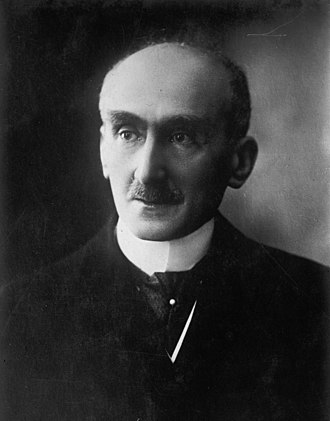
Henri Bergson
1859–1941 · French philosopher of Jewish origin, Nobel Prize in Literature in 1927
Henri Bergson (Paris, 1859 – Paris, 1941) was a French philosopher of Jewish origin and one of the most influential thinkers of the first half of the twentieth century. His work belongs to the continental tradition and grew out of a reaction against the positivism that dominated late nineteenth-century France. His lasting contribution lies in arguing that immediate experience and intuition grasp aspects of reality that abstract rationalism and science cannot reach. In 1927 he received the Nobel Prize in Literature for his ideas.
He was born into a family of Polish-Jewish background: his father, Michał Bergson, was a musician, and his mother had English and Irish roots. He spent his first years in London, and as a child moved with his family to France, where he later became a French citizen. He studied at the Lycée Condorcet and at the École Normale Supérieure, where he trained in philosophy. After several years teaching in provincial lycées, in Angers and Clermont-Ferrand among them, he defended in 1889 his dissertation on the immediate data of consciousness. He returned to the École Normale in 1898 and in 1900 took a chair at the Collège de France, where his lectures drew large crowds. In 1914 he was elected to the Académie française.
His major books form a clear sequence. In the Essay on the Immediate Data of Consciousness he analysed lived time, or duration, which cannot be measured as a string of separate instants. Matter and Memory (1896) distinguished a mechanical memory, built on habit and repetition, from a memory that preserves the past in its singularity. Laughter (1900) treated the comic as a mechanical stiffness that society corrects through ridicule, since life demands flexibility. In his Introduction to Metaphysics (1903) he set out his method: intuition, which enters an object from within, as opposed to analysis, which breaks it up from outside and serves mainly practical action. Creative Evolution (1907) argued that life is an impulse, the élan vital, that produces new forms and cannot be explained by mechanisms alone. The Two Sources of Morality and Religion (1932) contrasted a closed morality, sustained by social pressure and habit, with an open morality driven by mysticism and love.
In his thought, the decisive opposition is not between subject and object but between space and time. Space is the measurable, stable realm useful for action; time is duration, a creative continuity grasped only from within. Bergson criticised what he saw as false problems, produced by treating time as a series of static snapshots. This led him to debate Einstein's theory of relativity: he recognised its physical value but held that simultaneity does not exhaust the experience of lived time. Though ill during the German occupation, he presented himself in person to be registered as a Jew, and he opposed the Vichy regime in several ways.
His influence was considerable in France and beyond. Marcel Proust, a relative of his wife, read him closely, and his ideas inspired writers such as Antonio Machado. In 1966 Gilles Deleuze published Le Bergsonisme, which revived interest in his work. His critique of rationalism and his defence of lived experience anticipated later debates about consciousness and time. Today he is read as a thinker of creativity and freedom who used images and metaphors to say what abstract concepts cannot.
Key ideas
- Duration: lived time in consciousness is continuous and cannot be reduced to a sequence of separate instants.
- Intuition: a method for grasping reality from within, as opposed to analysis, which breaks it apart from outside.
- Élan vital: the creative impulse of life that accounts for the emergence of new forms in evolution.
- Pure memory: the past is preserved in its uniqueness, distinct from memory based on habit and repetition.
Books to read
- Laughter: An Essay on the Meaning of the Comic EnglishEPUB 157 KBRead online
- Time and Free Will: An Essay on the Immediate Data of Consciousness EnglishEPUB 266 KBRead online
- Dreams EnglishEPUB 86 KBRead online
- Creative Evolution EnglishGutenberg
- Henkinen tarmo FinnishGutenberg
Curiosities
A distinguished best man
Bergson married Louise Neuberger, a cousin of Marcel Proust, in 1891, and Proust served as best man at the wedding.
An unusual brother-in-law
Bergson's sister, Mina, married the occult author Samuel Liddell MacGregor Mathers, a founder of the Hermetic Order of the Golden Dawn.
Teachers and influences
Teachers
- Émile Boutroux 1845–1921
Pupils
- Marcel Proust 1871–1922
- Gabriel Marcel 1889–1973
- Jacques Maritain 1882–1973
- Louis Lavelle 1883–1951
- Jean Wahl 1888–1974
Influenced by
- Albert Einstein 1879–1955
- Aristotle 383 BC–321 BC
- Plato 428 BC–348 BC
- Charles Darwin 1809–1882
- Immanuel Kant 1724–1804
- René Descartes 1596–1650
- Gottfried Wilhelm Leibniz 1646–1716
- Blaise Pascal 1623–1662
- Benedictus de Spinoza 1632–1677
- Arthur Schopenhauer 1788–1860
- Søren Kierkegaard 1813–1855
- David Hume 1711–1776
- Herbert Spencer 1820–1903
- George Berkeley 1685–1753
- Plotinus 205–270
- Zeno of Elea 489 BC–424 BC
- Gottlob Frege 1848–1925
- Georg Simmel 1858–1918
- Jules Lachelier 1832–1918
Influenced
- Muhammad Iqbal 1877–1938
- Aurobindo Ghosh 1872–1950
- Oswald Spengler 1880–1936
- Gilles Deleuze 1925–1995
- Emil Cioran 1911–1995
- Georges Bataille 1897–1962
- Pierre Teilhard de Chardin 1881–1955
- Gabriel Marcel 1889–1973
- Georges Canguilhem 1904–1995
Original Filopedia text based on Wikipedia (es) and Wikipedia (en) and Wikidata.