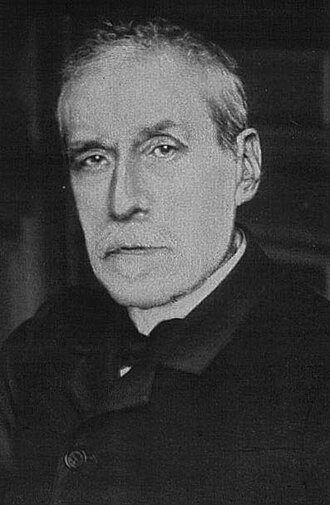
Émile Boutroux
1845–1921 · French philosopher of science and historian of philosophy
Émile Boutroux (1845-1921) was a French philosopher best known for his work on the philosophy of science and on the history of philosophy. He belonged to the spiritualist current in nineteenth-century France and became known for arguing that religion and science could coexist at a time when the prestige of science was rising steadily. His reputation in the English-speaking world has been overshadowed by that of his former pupil Henri Bergson, but in France he was a respected and influential figure.
Boutroux was born on 28 July 1845 at Montrouge, near Paris. He studied at the Lycée Napoléon (now Lycée Henri IV) and graduated in 1865 from the École Normale Supérieure. He later spent time at the University of Heidelberg, where he was exposed to German philosophy and to the teaching of Hermann von Helmholtz. In 1874 he defended two doctoral theses: one on the eternal truths in Descartes, supervised by Félix Ravaisson, and the other, "The Contingency of the Laws of Nature", supervised by Jules Lachelier. The second is his most famous work. Drawing on Kant, it asks how far natural laws are necessary and what their contingency means for scientific knowledge.
He taught philosophy at Caen and at the Faculty of Letters in Nancy, where he met Aline Poincaré, sister of the mathematician Henri Poincaré, and married her. Their son Pierre became a distinguished mathematician and historian of science. In 1888 Boutroux was appointed professor of the history of modern philosophy at the Sorbonne. He joined the Academy of Moral and Political Sciences in 1898, directed the Thiers Foundation from 1902 and was elected to the Académie française in 1912.
Among his principal works are La Grèce vaincue et les premiers stoïciens (1875), Socrates, Founder of Moral Science (1883), Natural Law in Science and Philosophy (1895), Pascal (1900), Psychology of Mysticism (1902) and Science and Religion in Contemporary Philosophy (1908). His view was that natural laws are useful for explaining phenomena but do not exhaust reality, and that freedom and contingency must be taken seriously against materialist determinism. His influence came mainly through Bergson and through those in France who sought to reconcile science, morality and religion. He died in Paris on 22 November 1921, a year after his son.
Key ideas
- Contingency of natural laws: laws of nature are real regularities, but not necessary in an absolute sense, and science does not exhaust them.
- Opposition to materialism: scientific materialism cannot explain everything, and consciousness and moral life require other approaches.
- Compatibility of science and religion: scientific inquiry and religious experience can coexist without contradiction.
- Historical spiritualism: his readings of Socrates, Pascal or Kant aim to show the moral and spiritual dimension of their thought.
Curiosities
Married into the Poincaré family
In Nancy he met Aline Poincaré, sister of the mathematician Henri Poincaré, and married her.
A mathematician son
His son Pierre, born in 1880, became a distinguished mathematician and historian of science.
Teachers and influences
Teachers
- Jules Lachelier 1832–1918
Pupils
- Henri Bergson 1859–1941
- Jacques Chevalier 1882–1962
Original Filopedia text based on Wikipedia (es) and Wikipedia (en) and Wikidata.