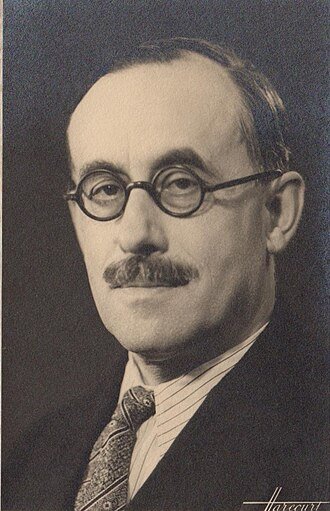
Jacques Chevalier
1882–1962 · French Catholic philosopher and spiritualist, disciple of Bergson
Jacques Chevalier (Cérilly, 1882 - Cérilly, 1962) was a French Catholic philosopher and a leading voice of French spiritualism. A disciple of Henri Bergson, he belonged to the spiritualist current that, around the turn of the twentieth century, sought to understand inner life in opposition to materialism and positivism.
He was educated at the École normale supérieure and spent time at the University of Oxford. He taught at the Faculty of Letters in Grenoble and became known as a specialist in Plato and as the author of many books on the history of philosophy. His works include studies of the pseudo-Platonic dialogue Axiochus, of necessity in Aristotle, and of Pascal, together with a four-volume History of Thought. He also wrote on habit as a subject for scientific metaphysics and on moral life and faith. His career extended into politics: he held ministerial office, including education, under the Vichy regime. There he pursued a reform that replaced the Écoles Normales with vocational training institutes, aimed at countering anti-religious feeling in educational circles. Opposition from anti-clerical collaborationists forced him to step down, and the reform was later reversed.
Key ideas
- Spiritualism: inner life, freedom and conscience cannot be reduced to material processes.
- Bergsonian inheritance: thought should start from the lived experience of duration rather than from abstract schemes.
- Habit: custom is a phenomenon that metaphysics can study rigorously, without losing sight of its moral dimension.
- Christian tradition: philosophy finds support in Pascal, Thomas Aquinas and Newman for thinking about the relation between faith and reason.
Curiosities
A lonely presence at a funeral
As education minister, he was the only member of the government to attend the funeral of Henri Bergson.
A short-lived reform
His attempt to replace the Écoles Normales was later abolished, and the schools were recreated.
Teachers and influences
Teachers
- Émile Boutroux 1845–1921
Pupils
- Emmanuel Mounier 1905–1950
Original Filopedia text based on Wikipedia (es) and Wikipedia (en) and Wikidata.