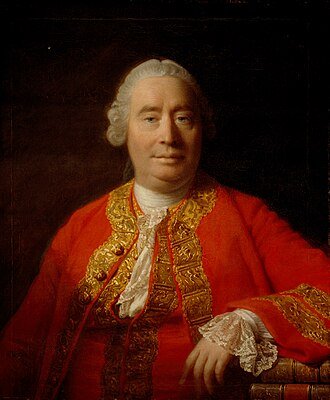
David Hume
1711–1776 · Scottish philosopher, historian and essayist
Early life and schooling
David Hume was born in Edinburgh on 7 May 1711 into a family of the minor gentry of the Anglo-Scottish border. He was the younger of two sons; his father, a lawyer, died when David was still a small child, and his mother moved to Ninewells to raise the children with her brother-in-law. In 1722, at about eleven, he entered the College of Edinburgh, where he studied the classics and encountered teachers who had been trained in Newtonian thought. His family expected him to become a lawyer, but he later recalled that from an early age his real attraction lay in philosophy and in the study of the human mind.
A crisis and the search for a vocation
Hume later described a period of intellectual and physical crisis around 1734. Weary of legal studies, he felt an insurmountable aversion to anything but philosophy and learning in general. He gave up the law and tried his hand at commerce in Bristol, but it did not suit him. He then moved to France and spent almost three years there, first at Reims and then at La Flèche in the Loire valley. Living frugally and with discipline, he devoted himself to reading and writing, and set out a plan of life in which material comfort was sacrificed in order to preserve his independence and his literary ambitions.
The Treatise of Human Nature
It was at La Flèche that, at the age of twenty-six, he finished the Treatise of Human Nature, whose three books appeared between 1739 and 1740. His reading of Locke and Berkeley had led him to question the idea of causation and to push empiricism to its furthest consequences. The Treatise aimed to apply the experimental method to moral questions and to build a science of man on the observation of the mind. Its reception was cold; it attracted little attention, and Hume later wrote that it had been stillborn from the press. The disappointment taught him the value of being clearly understood, and in later years he restated his ideas in the more accessible forms of the essay and the enquiry, genres in which he excelled.
Essays, religion and the History of England
After the modest fate of the Treatise, Hume published his Essays Moral and Political in 1741 and 1742, which were a considerable success. Around 1748 came the Enquiry Concerning Human Understanding, which restated much of the Treatise with greater clarity. His religious views, however, closed the doors of academic appointment: in 1744 he failed to obtain the chair of moral philosophy at Edinburgh, and later the chair at Glasgow, partly because his friend Adam Smith feared public reaction to his appointment. In 1752 he was elected librarian of the Faculty of Advocates in Edinburgh, a post that gave him a large library and the means to undertake historical research. Between 1754 and 1762 he published the six-volume History of England, which became a bestseller and the standard account of the nation for decades.
Paris, Rousseau and public office
Between 1763 and 1765 he served as secretary to the British embassy in Paris, where he was well received in the salons and befriended the philosophes. In 1766 he accompanied Jean-Jacques Rousseau to England at Rousseau's request, but the friendship collapsed in a public and bitter quarrel, partly because of Rousseau's psychological instability. Hume then became Under-Secretary of State for the Northern Department in London. A letter rediscovered in 2014 also shows that, acting for his patron Lord Hertford, he helped circulate an investment in Grenadian slave plantations, an episode that scholars assess with differing degrees of severity and that complicates his public statements against slavery.
Death and legacy
Back in Edinburgh, Hume spent his last years in comfortable circumstances among the friends of the Scottish Enlightenment. In 1775 he began to suffer from an abdominal tumour that slowly weakened him, and he died on 25 August 1776. Shortly before, he wrote My Own Life, a brief autobiography in which he described himself as gentle, cheerful and little inclined to hatred. Adam Smith was with him in his final days and recounted Hume's joking remarks about what he might say to Charon. His work influenced Kant, who acknowledged being roused from his 'dogmatic slumber' by Humean scepticism, and it has shaped utilitarianism, logical positivism, analytic philosophy and the philosophy of science, as well as the enduring debates on induction, causation and personal identity.
Key ideas
- Empiricism: all our knowledge comes from experience, since there are no innate ideas.
- The problem of induction: belief in causality cannot be justified by reason and rests instead on custom and mental habit.
- The primacy of the passions: human conduct and moral judgement rest more on feeling than on abstract principles of reason.
- The is-ought distinction: normative conclusions about what ought to be done cannot be derived from descriptive statements of fact alone.
Quotes
“Reason is, and ought only to be the slave of the passions.”
Where to start
An Enquiry Concerning Human Understanding 1748
Hume's Enquiry Concerning Human Understanding is a revised and shorter version of his Treatise, written with greater clarity and less technical apparatus. In it Hume presents accessibly his empiricism, the theory of ideas arising from impressions, and his famous critique of causation, the basis of how we know the world.
Next: An Enquiry Concerning the Principles of Morals. Having understood how we know, the Enquiry Concerning the Principles of Morals shows how Hume applies the same method to ethics, explaining the origin of virtue in human sentiments.
Works in Filopedia
Books to read
- An Enquiry Concerning Human Understanding EnglishEPUB 204 KBRead online
- A Treatise of Human Nature EnglishEPUB 639 KBRead online
- An Enquiry Concerning the Principles of Morals EnglishEPUB 190 KBRead online
- Dialogues Concerning Natural Religion EnglishEPUB 153 KBRead online
- Essays EnglishEPUB 145 KBRead online
- The History of England in Three Volumes, Vol. I., Part A. From the Britons of Early Times to King John EnglishEPUB 714 KBRead online
- Philosophical Works, v. 1 (of 4) Including All the Essays, and Exhibiting the More Important Alterations and Corrections in the Successive Editions Published by the Author EnglishEPUB 387 KBRead online
- The History of England in Three Volumes, Vol. I., Part B. From Henry III. to Richard III. EnglishEPUB 745 KBRead online
- The History of England in Three Volumes, Vol. I., Part E. From Charles I. to Cromwell EnglishEPUB 620 KBRead online
- Philosophical Works, v. 2 (of 4) Including All the Essays, and Exhibiting the More Important Alterations and Corrections in the Successive Editions Published by the Author EnglishEPUB 459 KBRead online
- The History of England in Three Volumes, Vol. I., Part C. From Henry VII. to Mary EnglishEPUB 673 KBRead online
- The History of England in Three Volumes, Vol. I., Part D. From Elizabeth to James I. EnglishEPUB 789 KBRead online
- Hume's Political Discourses EnglishEPUB 371 KBRead online
- The History of England in Three Volumes, Vol. I., Part F. From Charles II. to James II. EnglishEPUB 443 KBRead online
- A Treatise of Human Nature Being an Attempt to Introduce the Experimental Method Into Moral Subjects; and Dialogues Concerning Natural Religion EnglishEPUB 428 KBRead online
Curiosities
A name respelled
In 1734 he changed the spelling of his surname from Home to Hume, because the name, pronounced "Hume", was not well known in England.
An autobiography written near the end
He recounted his life in My Own Life, which he wrote four months before his death.
Teachers and influences
Influenced by
- Isaac Newton 1643–1727
- John Locke 1632–1704
- George Berkeley 1685–1753
- Francis Hutcheson 1694–1746
Influenced
- Albert Einstein 1879–1955
- Charles Darwin 1809–1882
- Immanuel Kant 1724–1804
- Bertrand Russell 1872–1970
- Arthur Schopenhauer 1788–1860
- Henri Bergson 1859–1941
- Edmund Burke 1729–1797
- Gilles Deleuze 1925–1995
- Jules Michelet 1798–1874
- Cesare Beccaria 1738–1794
- Saul Kripke 1940–2022
- Friedrich Heinrich Jacobi 1743–1819
- Thomas Reid 1710–1796
- Salomon Maimon 1754–1800
- Quentin Meillassoux b. 1967
Original Filopedia text based on Wikipedia (es) and Wikipedia (en) and Wikidata.