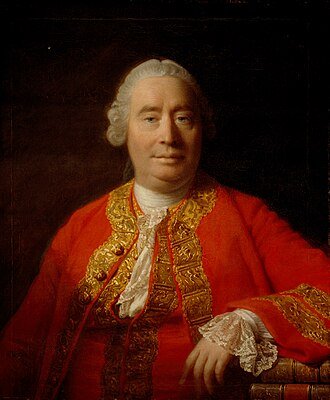
 AuthorDavid Hume1711–1776
A Treatise of Human Nature is a work by the Scottish philosopher David Hume, published in 1739, although it was written and appeared in three books between 1738 and 1740. Its original subtitle, An Attempt to Introduce the Experimental Method of Reasoning into Moral Subjects, states its purpose: to bring to the human mind the same empirical rigour that Isaac Newton had brought to physics. Hume aimed to discover the extent and force of human understanding and to build upon that inquiry all the sciences and philosophy.
Hume holds that all knowledge comes from experience. He divides perceptions into impressions, which are more forceful and vivid and include sensations, passions and emotions, and ideas, which are fainter copies of them. Against the rationalists, he argues that the passions, rather than reason, move human behaviour, and that reason can only serve our desires. Hence his famous claim that reason is, and ought only to be, the slave of the passions. In morality he maintains that the distinction between good and evil rests on sentiment rather than on rational deduction, and he insists on the gap between what is and what ought to be.
The work is also renowned for the problem of induction: the reasoning that carries us from what we have observed to what we have not, and our belief in causal connection, cannot be justified by reason, but arise from habit and custom. Hume adds a sceptical theory of personal identity, according to which the self is a succession of perceptions that we never grasp as a permanent core, and a compatibilist account of free will that reconciles human liberty with the causal necessity of events.
Its reception was cool. The Treatise barely stirred interest in Britain, and Hume himself acknowledged its failure by reworking much of its material into the Enquiry Concerning Human Understanding (1748) and the Enquiry Concerning the Principles of Morals (1751), more concise and polished versions. Over time, however, the book became one of the most influential works of modern philosophy. Isaiah Berlin wrote that no man had influenced the history of philosophy to a deeper or more disturbing degree, and Jerry Fodor regarded it as a foundational document of cognitive science.
Themes
Books to read
- A Treatise of Human Nature EnglishEPUB 639 KBRead online
- A Treatise of Human Nature Being an Attempt to Introduce the Experimental Method Into Moral Subjects; and Dialogues Concerning Natural Religion EnglishEPUB 428 KBRead online
Other works by David Hume
Original Filopedia text based on Wikipedia (es) and Wikipedia (en) and Wikidata.