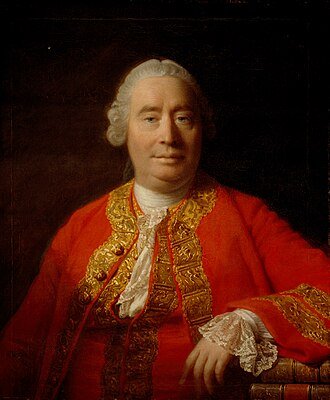
 AuthorDavid Hume1711–1776
An Enquiry Concerning the Principles of Morals is a work by the Scottish philosopher David Hume, published in 1751, three years after his Enquiry Concerning Human Understanding. It is therefore often called his "second Enquiry". Hume had discussed ethics in Book 3 of his A Treatise of Human Nature, but in this work he extracted and expanded those ideas in a shorter and more accessible form. Hume himself, in his brief autobiography My Own Life (1776), described it as incomparably the best of all his writings, whether historical, philosophical or literary.
Hume's method is largely empirical. Rather than starting from how morality ought to operate, he asks how we actually make moral judgments, and he aims to offer a naturalistic account of morality insofar as it is common to the human species. Whether this account amounts to a normative ethical theory, and not merely a descriptive theory of moral psychology, remains a matter of debate among scholars.
His central claim is that reason alone cannot move us to choose one moral option over another. Reason deals with facts and draws conclusions from them, but it does not motivate action on its own. It is our sentiments of approval and disapproval that allow us to distinguish virtue from vice. This sentimental foundation rests on sympathy, which Hume understands as a principle for communicating and sharing feelings, both positive and negative, much like what today is called empathy. Through sympathy we can be moved by non-selfish concerns, and Hume thereby rejects the psychological egoism associated with Thomas Hobbes. He also observes that most of the behaviours we approve of increase public utility.
As a first-order moral theory, the work belongs to a form of virtue ethics. What we evaluate are not isolated actions but the character of persons. Hume distinguishes natural virtues, present universally in human nature, from artificial virtues such as fidelity or justice, which arise from social institutions and may vary from one society to another. He also criticises the so-called monkish virtues, such as self-denial and humility, which in his view serve no useful or agreeable purpose, and he argues that a certain degree of luxury, or even pride, may be virtuous.
The work had a considerable influence on later moral philosophy. Its arguments against grounding morality in reason are regarded as precursors of the anti-realist positions later defended by John Mackie, and its distinction between natural and artificial virtues has continued to fuel debate about the origin of moral norms.
Themes
Books to read
- An Enquiry Concerning the Principles of Morals EnglishEPUB 190 KBRead online
Other works by David Hume
Original Filopedia text based on Wikipedia (es) and Wikipedia (en) and Wikidata.