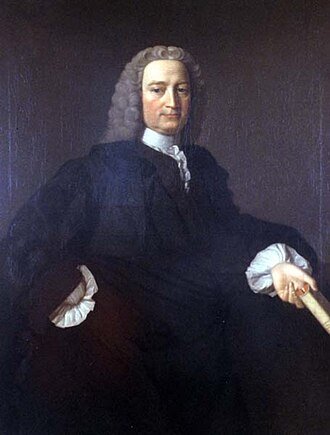
Francis Hutcheson
1694–1746 · Irish-Scottish moral philosopher and economist, a founder of the Scottish Enlightenment
Francis Hutcheson (1694-1746) was a philosopher born in what is now Northern Ireland to a family of Scottish descent, and one of the key figures of the early Scottish Enlightenment. Trained at Glasgow, he held the chair of Moral Philosophy there, and his thought shaped a generation of Scottish thinkers, from David Hume to Adam Smith and Thomas Reid.
According to tradition, Hutcheson was born at Drumalig in County Down, the son of a Presbyterian minister of Ulster-Scottish stock. He studied philosophy, classics and theology at Glasgow, and while still a student worked as tutor to the Earl of Kilmarnock. Suspicion about his Irish roots and his links to a theologian under ecclesiastical investigation made a career in Scotland unlikely, so he went back to Ireland. In Dublin he ran a private academy for eleven years and wrote the works that made his name, first published anonymously: the Inquiry into the Original of Our Ideas of Beauty and Virtue (1725) and the Essay on the Nature and Conduct of the Passions and Affections (1728).
In 1729 he succeeded his old teacher, Gershom Carmichael, in the chair at Glasgow, becoming the first professor there to lecture in English rather than Latin. His more systematic texts came later: A Short Introduction to Moral Philosophy (1747) and System of Moral Philosophy (1755), published after his death.
His central contribution is moral sense theory: humans possess an inner faculty that lets them perceive virtue and vice, and benevolence is the chief source of virtue. Hutcheson held that philosophy should have practical value rather than being a purely theoretical exercise, and this put him at odds with Hume's attempt to build a science of morals. His phrase 'the greatest happiness for the greatest number' anticipates later utilitarianism. He was also among the first to treat beauty as the product of an internal sense, helping establish aesthetics as a distinct field.
His influence reached Hume, Smith, Bentham and Reid, and his writings were widely read in Britain and colonial America. He is remembered too as a teacher whose personality and earnestness marked his students.
Key ideas
- Moral sense: an innate capacity to perceive virtue and vice in our own and others' actions and affections.
- Benevolence: the chief source of virtue, ahead of self-interest.
- Greatest happiness for the greatest number: the standard for judging an action by the good it produces for most people.
- Sense of beauty: the perception of beauty as an internal sense, distinct from the external senses.
- Practical philosophy: moral knowledge should guide life rather than remain theory.
Curiosities
A teacher known as a preacher of philosophy
His students called him the preacher of philosophy, for the fervour with which he urged them to live out what they learned, not merely to know it.
Publishing anonymously
His most important early works appeared without his name, though his authorship was well known among his contemporaries.
Teachers and influences
Influenced
- Immanuel Kant 1724–1804
- David Hume 1711–1776
Original Filopedia text based on Wikipedia (es) and Wikipedia (en) and Wikidata.