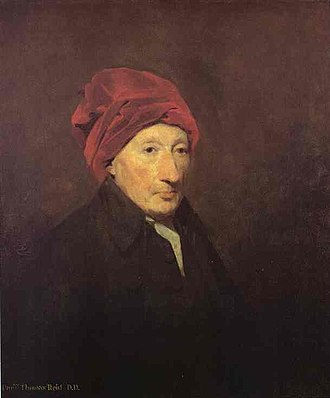
Thomas Reid
1710–1796 · Scottish philosopher of common sense
Thomas Reid (1710–1796) was a Scottish philosopher, a contemporary of David Hume and the founder of the Scottish School of Common Sense, which played a central role in the Scottish Enlightenment. He is remembered for arguing that certain basic beliefs shared by ordinary people are the starting point of any philosophical inquiry, rather than something that must be proven from scratch.
Born at Strachan, in north-east Scotland, he studied at Marischal College in Aberdeen, graduating in 1726. He was licensed to preach by the Church of Scotland in 1731 and worked as a minister until 1752, when he became a professor at King's College, Aberdeen. There he helped found a literary and philosophical society popularly known as the 'Wise Club'. In 1764 he published An Inquiry into the Human Mind on the Principles of Common Sense. Shortly afterwards he was appointed to the chair of moral philosophy at the University of Glasgow, succeeding Adam Smith, a post he resigned in 1781. His later major works, Essays on the Intellectual Powers of Man (1785) and Essays on the Active Powers of the Human Mind (1788), grew out of his university lectures. He died in Glasgow in 1796.
Reid held that common sense, understood in a precise philosophical sense, should lie at the foundation of all inquiry. He opposed Hume, who questioned causality and doubted that we could know anything of the world beyond our ideas, and George Berkeley, who reduced physical objects to ideas in the mind. Reid argued instead that perception puts us in direct contact with an external world. For him, rejecting the first principles of common sense led to absurdity and clashed with the way people live and act every day. Among these principles was belief in God, and he thought our faculties of perception, reason and morality could be trusted because they came from a benevolent Creator who would not systematically deceive us.
His theory of knowledge was closely tied to his ethics. He believed philosophy should confirm our common beliefs so that, once confirmed, we could simply act on them. His moral thought recalls Roman Stoicism, from which he took the term 'sensus communis', and it also engages the Christian tradition of Thomas Aquinas. Although his reputation declined after criticism from Kant and John Stuart Mill, his school was highly influential in North American universities in the nineteenth century. Charles S. Peirce, who shared his interest in rehabilitating common sense, shows his influence clearly. Today he is valued again, above all for his defence of direct realism and for his impact on analytic philosophy.
Key ideas
- Common sense as foundation: basic, widely shared beliefs are the starting point of any philosophical reasoning.
- Direct realism: we perceive external objects immediately, not only through ideas in the mind.
- Reliability of our faculties: perception, reason and morality can be trusted because they come from a Creator who does not deceive us.
- Ethics and knowledge: epistemology serves as an introduction to practical ethics, since confirmed common beliefs guide action.
- Rejection of the theory of ideas: he opposed the view, held by Locke and Descartes, that we know only mental representations.
Teachers and influences
Influenced by
- Cicero 106 BC–42 BC
- David Hume 1711–1776
Influenced
- Jaime Balmes 1810–1848
Original Filopedia text based on Wikipedia (es) and Wikipedia (en) and Wikidata.