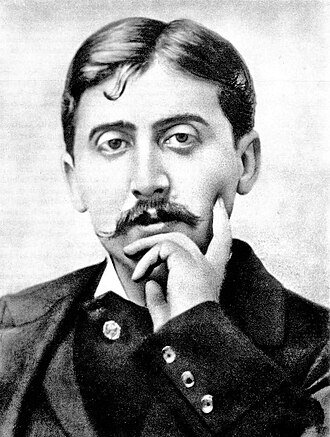
 AuthorMarcel Proust1871–1922
In Search of Lost Time is a novel by Marcel Proust, written between 1908 and 1922 and published in seven parts between 1913 and 1927. The last three volumes appeared after the author's death, working from drafts that he had not finished revising. It is one of the longest novels ever written, a fact recognised by the Guinness World Record for longest novel, and it is regarded as one of the summits of French and world literature.
The book follows a narrator who grows up in a bourgeois Parisian family at the turn of the twentieth century and who wants to become a writer. For years, however, he is drawn away from that goal by social life, aristocratic salons and fashionable seaside resorts, such as the fictional Balbec on the Normandy coast. Along the way he discovers love, jealousy, illness and homosexuality. War and ageing lead him to see the emptiness of that world and give him the key to his literary vocation. Rather than a sequence of events, the work is an exploration of memory and of the bonds it creates between past and present.
Its most famous episode comes early, in Swann's Way, when the narrator tastes a madeleine dipped in tea and the flavour suddenly brings back his childhood in Combray. That experience of involuntary memory runs through the whole work and sums up its central idea: lost time can only be recovered through art.
The novel took shape slowly. Proust had to pay for the publication of the first volume himself after several publishers turned it down. André Gide, who read it on behalf of the Nouvelle Revue Française, rejected it and later acknowledged the mistake. In the Shadow of Young Girls in Flower won the Prix Goncourt in 1919, and the book's reputation has grown steadily since then.
Its influence on twentieth-century literature has been considerable. Many writers have tried to emulate it and others have parodied it, and its treatment of time, memory and consciousness has shaped much of the fiction that followed. Proust drew on his own life, family and friendships, but the book should not be read as a simple autobiography.
Themes
Other works by Marcel Proust
Original Filopedia text based on Wikipedia (es) and Wikipedia (en) and Wikidata.