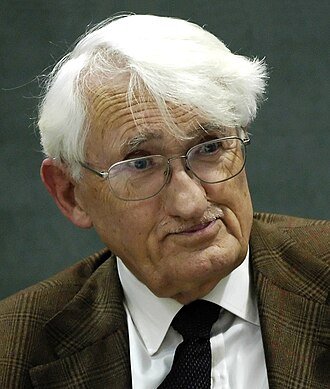
Jürgen Habermas
1929–2026 · German philosopher and sociologist, a key figure of critical theory
Origins and youth
Jürgen Habermas was born in Düsseldorf, in the Rhine Province, on 18 June 1929. He was born with a cleft palate and underwent corrective surgery several times in childhood. He later argued that this speech difficulty made him think differently about the importance of deep dependence and of communication.
Until he finished secondary school he lived in Gummersbach, near Cologne, in a staunchly Protestant environment; his grandfather had directed the local seminary there. His father, Ernst Habermas, was executive director of the Chamber of Industry and Commerce of Cologne. He joined the Nazi Party in 1933 and advised it from 1939. At his father's urging, the young Habermas joined the Deutsches Jungvolk, the junior section of the Hitler Youth, and rose to the rank of Jungvolkführer, which allowed him to stay in the organisation beyond the age of fourteen. During the Second World War he was trained in first aid, and from August 1944 his unit operated anti-aircraft guns against the Allied advance on the Siegfried Line. Shortly before American troops reached his region, he narrowly avoided being conscripted into the Wehrmacht.
Academic training
After the war he studied philosophy, history, psychology, German literature and economics at the universities of Göttingen (1949–1950), Zurich (1950–1951) and Bonn (1951–1954). His teachers included Nicolai Hartmann, Theodor Litt, Erich Rothacker and Oskar Becker. In February 1954 he earned his doctorate at Bonn with a dissertation on Schelling, entitled roughly
Key ideas
- Communicative rationality: reason rests on understanding between subjects mediated by language, not only on calculating means and ends.
- Discourse ethics: a norm is valid if all those affected could accept it after free and equal deliberation.
- Deliberative democracy: political legitimacy depends on public discussion and the rational formation of opinion, not only on voting.
- Unfinished project: the Enlightenment should not be abandoned but corrected through critique and dialogue.
Quotes
“Since Hillgruber does not use the verb in the subjunctive, one does not know whether the historian has adopted the perspective of the particulars this time too.”
Where to start
Knowledge and Human Interests 1968
Knowledge and Human Interests is an accessible and representative entry point into Habermas's thought. It examines how the natural sciences, the historical-hermeneutic sciences and psychoanalysis each respond to different human interests, and proposes emancipation as the ultimate interest of knowledge. It is a good starting point for his work.
Next: The Theory of Communicative Action. The Theory of Communicative Action then develops these ideas into a full theory of language and communicative rationality, forming his major system.
Works in Filopedia
Curiosities
An early review
In 1953 he published a critique of Heidegger's Introduction to Metaphysics titled 'Thinking with Heidegger against Heidegger', in which he questioned Heidegger's adherence to National Socialism.
A clash with Horkheimer
Horkheimer tried to block the publication of a study on the political consciousness of Frankfurt students in which Habermas had taken part, a dispute that contributed to his departure from the institute.
A break with the School
In 1971 he wrote to Herbert Marcuse declaring his definitive break with the Frankfurt School.
Teachers and influences
Teachers
- Theodor W. Adorno 1903–1969
- Max Horkheimer 1895–1973
Influenced by
- Karl Marx 1818–1883
- Friedrich Nietzsche 1844–1900
- Immanuel Kant 1724–1804
- Sigmund Freud 1856–1939
- Friedrich Engels 1820–1895
- Georg Wilhelm Friedrich Hegel 1770–1831
- Rosa Luxemburg 1871–1919
- Max Weber 1864–1920
- Hannah Arendt 1906–1975
- Émile Durkheim 1858–1917
- Jean Piaget 1896–1980
- Theodor W. Adorno 1903–1969
- Edmund Husserl 1859–1938
- Wilhelm von Humboldt 1767–1835
- Friedrich Wilhelm Joseph Schelling 1775–1854
- Herbert Marcuse 1898–1979
- Georg Lukács 1885–1971
- Max Horkheimer 1895–1973
- George Herbert Mead 1863–1931
- Niklas Luhmann 1927–1998
- Karl-Otto Apel 1922–2017
Influenced
- Hans-Hermann Hoppe b. 1949
- Ken Wilber b. 1949
- André Gorz 1923–2007
- Karl-Otto Apel 1922–2017
- Axel Honneth b. 1949
- Seyla Benhabib b. 1950
Original Filopedia text based on Wikipedia (es) and Wikipedia (en) and Wikidata.