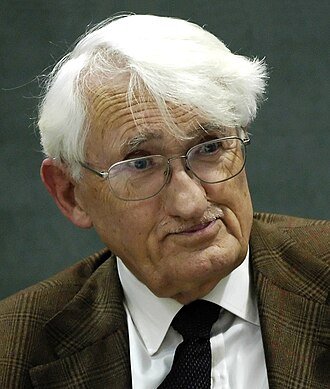
 AuthorJürgen Habermas1929–2026
Knowledge and Human Interests is a book published in 1968 by the German philosopher Jürgen Habermas, regarded as his first major systematic work. In it he examines the development of the modern natural and human sciences, aiming to analyze the connections between knowledge and human interests. Habermas builds on an idea which, in his account, is implicit in Karl Marx's theory of society, and argues that knowledge is never neutral but responds to interests linked to technical control, understanding, and emancipation.
The book traces the history of positivism and shows how modern philosophy has focused largely on epistemology, that is, on the question of how reliable knowledge is possible. For Habermas, rationalism and empiricism both shared a concern with the metaphysical demarcation of the realm of objects and with justifying a natural science characterized by formalized language and experiment. After Hegel's critique of Kant, he argues, philosophy and science drifted apart, so that science was no longer seriously comprehended by philosophy, making it necessary to reexamine the nature of scientific knowledge.
The discussion includes thinkers such as Fichte, Comte, Mach, Peirce, Dilthey and Husserl, and Habermas gives particular attention to hermeneutics in his treatment of Dilthey. His most prominent analysis concerns Sigmund Freud. He claims that psychoanalysis is the only tangible example of a science incorporating methodical self-reflection, yet its potential to exceed the limits of positivism went unrealized because of its self-misunderstanding as a natural science. He also critiques Nietzsche for tacitly accepting some basic positivist assumptions.
The book received mixed assessments. Some critics found it promising and part of an important body of work, while others pointed to its obscure style and to the limits of its philosophical analysis. His discussion of Freud sparked a debate that lasted for decades, with objections from critics such as Grünbaum, and its influence reached philosophy, psychoanalysis, and educational research.
Themes
Other works by Jürgen Habermas
Original Filopedia text based on Wikipedia (en) and Wikidata.