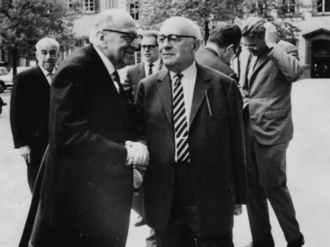
Max Horkheimer
1895–1973 · German philosopher and sociologist, a central figure of critical theory
Max Horkheimer (Stuttgart, 1895 – Nuremberg, 1973) was a German philosopher and sociologist, and the director of the Institute for Social Research in Frankfurt, the home of what became known as the Frankfurt School. Trained in German philosophy and shaped by Marxism, though never a strict orthodox Marxist, he was concerned with the relationship between reason, society and human suffering. His lasting contribution lies in showing how modern reason, reduced to calculating means and ends, can turn against the emancipation it once promised.
He was born into a wealthy, conservative Jewish family that owned textile factories. His father expected him to take over the business, so he left school at sixteen to work there. The First World War interrupted that path: he was called up, but later rejected on medical grounds. After the war he studied philosophy and psychology in Munich and then in Frankfurt under Hans Cornelius, where he formed a lasting friendship with Theodor Adorno. He qualified as a lecturer in 1925 with a study of Kant's Critique of Judgment and in 1930 took over the Institute for Social Research, which he steered towards interdisciplinary work combining Marx and Freud.
When the Nazis came to power, the institute was closed in 1933. Horkheimer emigrated to Switzerland and then to New York, where Columbia University gave the institute a home in exile. In 1940 he became an American citizen and moved to California, where, together with Adorno, he wrote Dialectic of Enlightenment, published in 1947. That same year saw Eclipse of Reason, which separates a reason able to judge worthwhile ends from a reason reduced to technical efficiency. For both thinkers, Enlightenment progress had produced new forms of domination, from the culture industry to authoritarianism.
He returned to Frankfurt in 1949, and the institute reopened there in 1950. He served as rector of the university from 1951 to 1953 and, although he published little in his final years, he remained a public and academic figure. He died in Nuremberg in 1973 and was buried in the Jewish cemetery in Bern, beside his wife. His influence is considerable: critical theory shaped generations of thinkers, and his student Jürgen Habermas reworked it into his theory of communicative action. His writings continue to be read in social philosophy, cultural studies and debates about democracy and technology.
Key ideas
- Instrumental reason: reason reduced to calculating efficient means, without the capacity to judge worthwhile ends.
- Dialectic of Enlightenment: the rational progress of modernity also produces domination and a loss of autonomy.
- Critical theory: social knowledge must analyse the conditions that sustain injustice and guide their transformation.
- Marx and Freud together: historical materialism and psychoanalysis are combined to explain society and the psychological roots of authoritarianism.
Where to start
Eclipse of Reason 1947
Critique of Instrumental Reason is an accessible entry point to Horkheimer: a brief, clear essay that lays out his diagnosis of how reason has been reduced to calculating means for ends. The reader will find the core ideas of critical theory without needing specialized training.
Next: Dialectic of Enlightenment. Dialectic of Enlightenment develops these same ideas further, showing how Enlightenment rational progress can turn into domination, and is the key text of the Frankfurt School.
Works in Filopedia
Curiosities
Mistaken identity
In Munich he was mistaken for the revolutionary playwright Ernst Toller and was arrested and imprisoned.
A marriage against his father's wishes
His father did not consider Rose Riekher, a Christian from a lower social class, a suitable match. They married in 1926 and stayed together until her death in 1969.
A burial in Bern
He was buried in the Jewish cemetery in Bern, next to his wife.
Teachers and influences
Pupils
- Jürgen Habermas 1929–2026
Influenced
- Theodor W. Adorno 1903–1969
- Jürgen Habermas 1929–2026
- Axel Honneth b. 1949
Original Filopedia text based on Wikipedia (es) and Wikipedia (en) and Wikidata.