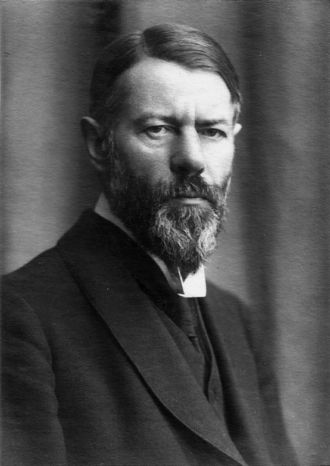
Max Weber
1864–1920 · German sociologist, economist and historian, one of the founders of modern sociology
Early life
Maximilian Karl Emil Weber was born in Erfurt, in Thuringia, on 21 April 1864, the eldest of seven children. His father, Max Weber Sr., was a lawyer, a Protestant civil servant and a prominent politician of the National Liberal Party in the Bismarck era. His mother, Helene, was a moderate Calvinist. The family home regularly welcomed scholars and public figures, so the young Weber grew up in a strongly intellectual atmosphere. His brother Alfred would also become a sociologist and economist.
Early promise
Weber was intellectually precocious. At twelve he gave his parents, as a Christmas present, two historical essays: one on the course of German history and one on the Roman Empire from Constantine to the migrations. Before entering university he was already well read in Goethe, Spinoza, Kant and Schopenhauer, and in his letters as a teenager he quoted Homer, Virgil, Cicero and Livy.
University years
In 1882 he began law at Heidelberg, where he also took courses in economics and medieval history. His uncle, the liberal historian Hermann Baumgarten, was among his teachers and an important influence on his liberalism and his critical view of Bismarck's domination of German politics. After a spell of military service he studied in Berlin and Göttingen. He lived with his parents for much of this period, and in 1886 he passed the Referendar examination that qualified him to practise as a lawyer.
In 1889 he earned his doctorate in law with a thesis on the history of medieval commercial partnerships. Two years later he presented his habilitation on Roman agrarian history and its significance for public and private law, which qualified him for a university chair.
Early academic career
In 1888 he joined the Verein für Socialpolitik, an association of economists linked to the historical school and a pioneer in large-scale statistical research. In 1890 he was put in charge of a study of the so-called Polish question: the migration of foreign farm labourers into eastern Germany while local workers moved to the industrialising cities. His report was widely praised and established his reputation as an expert in agrarian economics.
In 1893 he married his distant cousin Marianne Schnitger, who later became a feminist writer in her own right and played a decisive role in preserving and publishing his work after his death. That year he was appointed professor of economics at Freiburg, and in 1896 he moved to Heidelberg.
Breakdown and silence
In 1897 his father died, two months after a bitter quarrel between them that was never resolved. Weber then suffered from nervousness, insomnia and depression that made it impossible for him to teach. After months in sanatoria he travelled to Italy with his wife in 1900, and he published almost nothing between 1898 and 1902. In 1903 he resigned his chair, but he continued working as a private scholar, helped by an inheritance received by his wife in 1907.
The Protestant Ethic and the mature work
After his recovery, Weber became an associate editor of the Archiv für Sozialwissenschaft und Sozialpolitik alongside Edgar Jaffé and Werner Sombart, turning it into one of the most prestigious social science journals. There, in 1904 and 1905, he published The Protestant Ethic and the Spirit of Capitalism, his best-known work. In 1904 he also visited the United States, travelling through German and African American communities and visiting relatives of his mother's family in North Carolina.
He then turned to the Russian Revolution of 1905, learned Russian within a few months and wrote essays on the peasantry and the village commune. In 1909 he co-founded the German Sociological Association and served as its first treasurer until 1912, when he left the post over disagreements about the value-neutrality of the discipline.
War, politics and final years
When the First World War broke out he volunteered and organised army hospitals in Heidelberg. At first he supported the German war effort, but he later became a critic of imperial expansion and of the Kaiser's policies, and he argued for constitutional reform and universal suffrage. In 1919 he ran unsuccessfully for the Weimar National Assembly for the German Democratic Party, which he had helped found, and he advised on the drafting of the Weimar Constitution. He also gave the lectures Science as a Vocation and Politics as a Vocation in 1917 and 1919.
Back in teaching from 1918, he lectured in Vienna and then at the University of Munich, where he directed the first sociology institute established at a German university, though he never held a chair in sociology. He died of pneumonia in Munich on 14 June 1920, aged fifty-six, probably after contracting Spanish flu. His major work, Economy and Society, was left unfinished and was published posthumously in 1921 and 1922 thanks to the efforts of Marianne Weber.
Ideas and method
The core of his thought is social action, which he classified into four types: affectual, traditional, instrumental and value-rational. To understand it he proposed verstehen, or interpretive understanding, the idea that the researcher must grasp the subjective meaning individuals give to their actions. His key conceptual tool was the ideal type, an abstract construction that exaggerates the features of a phenomenon in order to compare it with reality, without claiming to reproduce it.
His concept of rationalisation runs through all his work. He described how modern life is increasingly organised around calculation and efficiency, and warned that this leads to the disenchantment of the world, a loss of meaning he likened to an iron cage. This diagnosis connects with his insistence on value-freedom in science: scholars can explain how values operate in history, but cannot decide which values are correct.
In the sociology of religion, The Protestant Ethic argued that a Calvinist ethic, with its emphasis on vocation and on success as a sign of divine election, encouraged the rational mentality of the capitalist enterprise. This thesis was followed by studies of China, India and ancient Judaism, in which he sought to explain why modern capitalism emerged in the West. In politics he defined the state as the entity claiming a legitimate monopoly on physical force, and he distinguished three forms of authority: charismatic, traditional and legal-rational.
Reception and legacy
After his death, the rise of Weberian scholarship was slowed by the instability of the Weimar Republic and then by Nazism. After the war, Talcott Parsons promoted his reception in the United States, and his work spread widely from there. He is now regarded, together with Karl Marx and Émile Durkheim, as one of the founding fathers of modern sociology. His legacy also extends to economics, political science and the study of bureaucracy, and his role in the politics of his time remains a subject of debate.
Key ideas
- Rationalisation and disenchantment of the world: Western modernity is marked by the spread of calculating rationality into nearly every area of life.
- Protestant ethic and capitalism: the Calvinist ethic of vocation and discipline encouraged a rational attitude toward work and profit that helped build modern capitalism.
- Monopoly on legitimate violence: the state is defined by its claim to the legitimate use of physical force within a territory.
- Types of authority: the legitimacy of power may be charismatic, traditional or legal-rational.
- Antipositivism and interpretation: the social sciences should study human action by grasping its meaning, not merely by observing regularities.
Where to start
The Protestant Ethic and the Spirit of Capitalism 1905
It is Weber's most accessible entry point: a short, well-argued essay that shows his comparative method. It explains how certain religious beliefs, notably the Puritan ethic of work and vocation, may have favored the rise of modern capitalism. The reader will find an original thesis in clear prose.
Next: Politics as a Vocation. Politics as a Vocation takes the idea of vocation into a concrete field and is a short, widely cited reading on power and the state.
Works in Filopedia
Curiosities
Teenage essays
At twelve or thirteen he gave his parents historical essays on German history and the Roman Empire.
An unresolved quarrel
His father died in 1897, two months after a heated argument that the two never had the chance to resolve.
Teachers and influences
Pupils
- Alfred Schütz 1899–1959
Influenced
- Jürgen Habermas 1929–2026
- Karl Jaspers 1883–1969
- Pierre Bourdieu 1930–2002
- Georg Simmel 1858–1918
- Alexander Dugin b. 1962
- Raymond Aron 1905–1983
- Ernst Bloch 1885–1977
- Norbert Elias 1897–1990
- Andrey Korotayev b. 1961
- André Gorz 1923–2007
Original Filopedia text based on Wikipedia (es) and Wikipedia (en) and Wikidata.