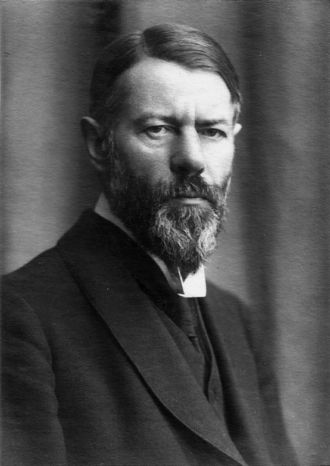
 AuthorMax Weber1864–1920
Politics as a Vocation is an essay by the German economist and sociologist Max Weber, published in 1919 and regarded as a classic of sociology and political science. It grew out of the second of two lectures Weber gave in Munich on 28 January 1919 to the Free Students' Union of Bavaria; the first was Science as a Vocation. He spoke from handwritten notes, later transcribed by a stenographer, and an expanded version appeared in July 1919. The setting matters: Germany was in the throes of the November 1918 revolution, and Munich had briefly been the capital of the Bavarian Soviet Republic. The essay was translated into English only after the Second World War, and its 1959 French edition, with a long preface by Raymond Aron, did much to establish the author's reputation in France.
The essay begins with Weber's classic definition of the state as the entity that claims a monopoly on the legitimate use of physical force within a given territory. From this, he defines politics as the pursuit of a share of power, or the effort to influence how power is divided, whether between states or among the groups within a single state. Weber identifies three grounds on which political domination claims legitimacy: traditional authority, resting on custom and an eternal past; charismatic authority, grounded in the gifts, heroism or exceptional qualities of an individual; and legal-rational authority, based on valid statutes enforced by technically trained officials. Much of the text traces the historical emergence of modern politics, with particular attention to Britain, the United States and Germany, and examines the relations between politicians, parties and the bureaucracies they build.
The closing part develops his best-known thesis: the politician must reconcile an ethic of conviction, loyal to unshakeable principles, with an ethic of responsibility, which accepts the foreseeable consequences of action and the everyday use of state violence in the name of peace. Weber warns that vanity and proximity to the instruments of coercion make political practice perilous, and he reflects on this with references to Luther's doctrine of the two kingdoms and the Upanishads. He ends on a sombre note about the revolution of his day, yet leaves a famous demand: only one who can say "In spite of all!" has a calling for politics.
Themes
Other works by Max Weber
Original Filopedia text based on Wikipedia (es) and Wikipedia (en) and Wikidata.