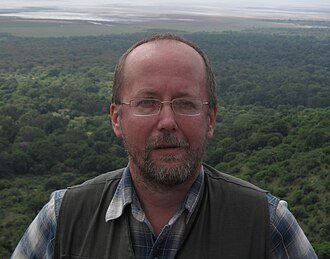
Andrey Korotayev
b. 1961 · Russian anthropologist, historian and sociologist, specialist in cliodynamics and world-systems theory
Andrey Korotayev (born in Moscow in 1961) is a Russian anthropologist, historian, economist and sociologist who works at the crossroads of the social sciences, history and mathematics. He is best known for cliodynamics, an approach that applies mathematical models to the evolution of societies, and for his contributions to world-systems theory, where he has become one of the most active voices in contemporary Russia. His work matters because it treats human history as a process that can be described with equations and tested against data.
He studied at Moscow State University and earned a doctorate from the University of Manchester in 1993. In 1998 he received a Doctor of Sciences degree from the Russian Academy of Sciences. Since 2000 he has combined teaching and directing an anthropology centre at the Russian State University for the Humanities with research at institutes of the Academy. He spent 2003 and 2004 as a visiting member at the Institute for Advanced Study in Princeton and has served as co-editor of journals such as Social Evolution and History. With Askar Akayev and George Malinetsky he coordinated a Russian Academy programme devoted to the mathematical analysis of global dynamics.
One of his central ideas is a positive feedback loop between population growth and technological development. Working with Artemy Malkov and Daria Khaltourina, he showed that until the 1970s the hyperbolic growth of the world population went together with a quadratic-hyperbolic growth of world GDP. In this model, more people produce more potential inventors, who speed up innovation, which in turn raises the carrying capacity of the planet and allows for still more people. Korotayev argues that since the 1970s the world system no longer follows that accelerating pattern and has been moving away from it.
His work on population and warfare, done with Peter Turchin, is another key contribution. Earlier studies had struggled to find a direct correlation between population density and war. He and Turchin showed that the two variables can oscillate out of phase, with peaks of conflict following peaks of population, so that simultaneous measurements tend to miss the link. They tested the model on early modern England, the Han and Tang dynasties in China, and the Roman Empire. He has also studied Russia's demographic crisis and the role of alcohol in mortality, and modelled Egypt's long-term political and demographic dynamics.
His influence is felt above all in cliodynamics and world-systems studies. His models remain a reference point in the debate over whether history can be treated as a quantifiable phenomenon, and how far his extrapolations on a millennial scale can be sustained is still an open question.
Key ideas
- Demographic-technological positive feedback: population growth and innovation reinforce each other, a dynamic that accounts for the hyperbolic growth observed until the 1970s.
- Cliodynamics: the history of societies can be modelled mathematically by combining very long-term trends with secular cycles.
- Population and warfare: demographic pressure and internal conflict oscillate out of phase, so their link does not always show up in simultaneous data.
- Malthusian trap: the gap between population and resources tends to produce sociopolitical upheaval, and escaping that trap opens another one that generates new turmoil.
Curiosities
An early prediction about Egypt
According to the sources, he was one of the first to predict and assess the Egyptian protests of June 2013.
A demographic forecast
In late 2014, together with Daria Khaltourina, he forecast the return of Russia to negative natural population growth.
Teachers and influences
Influenced by
- Max Weber 1864–1920
Original Filopedia text based on Wikipedia (es) and Wikipedia (en) and Wikidata.