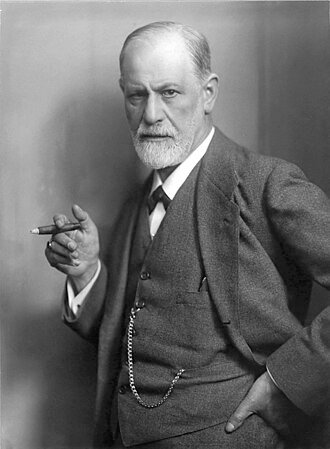
 AuthorSigmund Freud1856–1939
Totem and Taboo is a book by Sigmund Freud, the founder of psychoanalysis, in which he applies his ideas to archaeology, anthropology and the study of religion. Its German title, Totem und Tabu. Einige Übereinstimmungen im Seelenleben der Wilden und der Neurotiker, announces its aim: to draw parallels between the mental life of so-called primitive peoples and that of neurotics. It was first published as four essays in the journal Imago between 1912 and 1913, and appeared as a book in 1913. Freud, who had long been interested in social anthropology, archaeology and prehistory, acknowledged that the work of Wilhelm Wundt and Carl Jung gave him his first stimulus to write these essays, and he drew also on James George Frazer, especially The Golden Bough. The book was later translated into English twice, first by Abraham Brill and then by James Strachey.
The book is made up of four essays. The first, "The Horror of Incest", looks at the totemism of Aboriginal Australians, in which each clan is associated with a totem, usually an animal but sometimes a plant or natural force, and marriage within the same totem is forbidden. Freud reads this rule as a safeguard against incest and notes similar avoidance practices elsewhere. The second, "Taboo and Emotional Ambivalence", uses the concepts of projection and ambivalence, developed in his clinical work in Vienna, to explain taboo as the expression of contradictory feelings toward people and objects, feelings that are projected onto the totem. The third, "Animism, Magic and the Omnipotence of Thoughts", describes a stage in which people believe their thoughts have direct power over the world, a trait Freud also finds in obsessive thinking, delusions and phobias, and which survives in art. The fourth, "The Return of Totemism in Childhood", treats childhood animal phobia as a return to totemism and, drawing on Charles Darwin's speculations and William Robertson Smith's ideas about sacrifice, puts forward his central hypothesis: a primitive horde dominated by a violent father, whose sons kill and eat him, and whose subsequent remorse gives rise to the prohibition of killing the totem animal and of incest.
The book thus proposes a parallel between the development of societies and that of the individual, placing in a single originary act the beginnings of culture, religion and the superego. Its reception has been deeply divided. Alfred Kroeber, Franz Boas and Robert Ranulph Marett rejected it as speculative and empirically weak, and Carl Furtmüller criticized in 1914 its author's growing isolation from the scientific world. Thomas Mann, by contrast, praised it in 1929 as a masterpiece of German essay writing. Over time it became a meeting point between psychoanalysis and ethnology, and Claude Lévi-Strauss's structural anthropology drew some inspiration from it, though the book remains hotly debated.
Themes
Books to read
- Totem and taboo : Resemblances between the psychic lives of savages and neurotics EnglishGutenberg
Other works by Sigmund Freud
Original Filopedia text based on Wikipedia (es) and Wikipedia (en) and Wikidata.