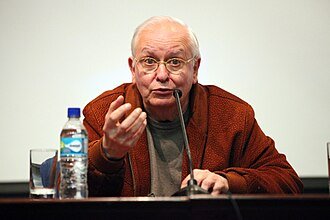
Ernesto Laclau
1935–2014 · Argentine philosopher and post-Marxist political theorist
Ernesto Laclau (Buenos Aires, 1935 – Seville, 2014) was an Argentine philosopher and political theorist, widely regarded as one of the main figures of post-Marxist thought. He developed a distinctive approach to discourse analysis, known as the Essex School, which brought together poststructuralism, psychoanalysis and political theory to examine how identities and hegemonies take shape.
He studied history at the University of Buenos Aires, graduating in 1964. In his youth he was active in left-wing politics, first in the Socialist Party of the National Left, led by Jorge Abelardo Ramos, whose Trotskyist and Latin American outlook sought closer ties with Peronism. In 1969 he moved to Britain, where the historian Eric Hobsbawm helped him gain a place at St Antony's College, Oxford. He completed his doctorate at the University of Essex in 1977 and became Professor of Political Theory there in 1986, directing its postgraduate programme in Ideology and Discourse Analysis.
His best-known work, Hegemony and Socialist Strategy, written with the Belgian political theorist Chantal Mouffe, his partner for more than thirty years, rejected Marxist economic determinism and the idea that class struggle is the decisive antagonism in society. In its place the two advocated radical and plural democracy, in which conflicting interests could be openly expressed. For Laclau, society never fully closes: a constitutive lack prevents its completion, and politics becomes a struggle for hegemony, that is, for the capacity to bind diverse demands around shared, floating signifiers.
In later books such as On Populist Reason he argued that populism is not a threat to democracy but an essential part of it, since it allows heterogeneous demands to form a collective people. His influence reaches political theory, cultural studies and discourse analysis, and his long exchanges with Slavoj Žižek and Judith Butler shaped much critical thought in the early twenty-first century.
Key ideas
- Radical and plural democracy: a political project that accepts a plurality of antagonisms, in which values such as liberty and equality remain open to contested interpretation.
- Antagonism and an incomplete society: society cannot close into a full totality, because a constitutive lack prevents its completion.
- Hegemony and empty signifiers: politics is the struggle to articulate diverse demands around signifiers that unify them.
- Discourse as social construction: the meaning of social entities is not given in advance but is constituted through relational discursive practices.
- Populism as part of democracy: for Laclau, the creation of a people out of heterogeneous demands is an essential mechanism of democratic politics.
Curiosities
Death in Seville
He died of a heart attack in Seville on 13 April 2014, aged 78.
A debate with Žižek
Laclau maintained a long intellectual dialogue with Slavoj Žižek that became a public dispute in the 2000s.
Teachers and influences
Influenced
- Slavoj Žižek b. 1949
Original Filopedia text based on Wikipedia (es) and Wikipedia (en) and Wikidata.