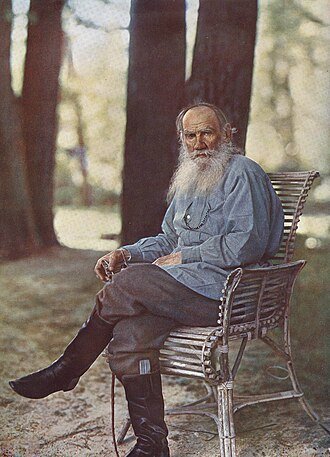
 AuthorLeo Tolstoy1828–1910
Resurrection (Russian: Воскресение, Voskreséniye) is a novel by Leo Tolstoy first published in December 1899. It was the last of his major works of fiction to appear during his lifetime. Tolstoy conceived it as a panoramic view of Russia at the close of the nineteenth century, moving from the highest to the lowest levels of society, and as an indictment of the injustice of man-made laws and the hypocrisy of the institutionalized church. The book also expounds the economic ideas of Georgism, of which Tolstoy had become a strong advocate late in life. Its publication led the Holy Synod to excommunicate him from the Russian Orthodox Church in 1901.
The story was suggested to him by his friend, the jurist Anatoly Koni, who told him of a man who had come to him seeking legal help. In his youth this man had seduced a sixteen-year-old orphan who had been taken in by a relative of his. When the benefactress discovered the pregnancy, she turned the girl out. Abandoned, she eventually became a prostitute, and when she was arrested for stealing from a drunken client, the jury that tried her included her former seducer. Stirred by the injustice of his conduct, he wished to marry her, but she died of typhus soon after serving her sentence. The account struck Tolstoy partly because it echoed an episode from his own youth. To help fund the emigration of the Dukhobors, persecuted Christian pacifists, he hurried the writing and sold the novel for simultaneous serial publication in several countries, which required some cuts under censorship. It first appeared in the Russian weekly Niva, illustrated by Leonid Pasternak, and in the American monthly The Cosmopolitan as The Awakening. The complete text was not published in Russia until 1936.
The novel follows the nobleman Dmitri Nekhlyudov, who seeks redemption for a wrong committed in his youth. As a young man on his aunts' estate, he fell in love with their ward, Katyusha Maslova. After being corrupted by city life, he returned and seduced her, leaving her pregnant; his aunt dismissed her, and she gradually fell into prostitution. Ten years later Nekhlyudov sits on the jury that unjustly sentences her to Siberian exile for a poisoning she did not commit. Rather than focusing on practical assistance, the book centres on his moral and spiritual struggle: through his prison visits he discovers a world of cruelty, arbitrariness and suffering hidden from his aristocratic life. He resolves to give up his land, returning it to the peasants, and follows Katyusha into exile. When she falls in love with another man, he generously blesses the match and chooses to remain among the convicts, still seeking redemption.
The book was eagerly awaited and sold remarkably well, initially outselling Anna Karenina and War and Peace. Critics later judged it inferior to those masterpieces, pointing to one-dimensional characters and less attention to detail, though it is still valued as an important document of pre-revolutionary Russian social conscience. It inspired operas, including works by Franco Alfano and Ján Cikker, and many films, among them Samuel Goldwyn's We Live Again (1934), directed by Rouben Mamoulian.
Themes
Books to read
- Resurrection EnglishEPUB 486 KBRead online
Other works by Leo Tolstoy
- Childhood 1852
- Sebastopol Sketches 1855
- War and Peace 1869
- Anna Karenina 1877
- A Confession 1882
- The Kreutzer Sonata 1889
- What Is Art? 1897
- Father Sergius 1911
- The Devil 1911
- Hadji Murat 1912
- The Kingdom of God Is Within You
Original Filopedia text based on Wikipedia (es) and Wikipedia (en) and Wikidata.