A Confession
autobiographical narrative and philosophical-religious essay · 1882
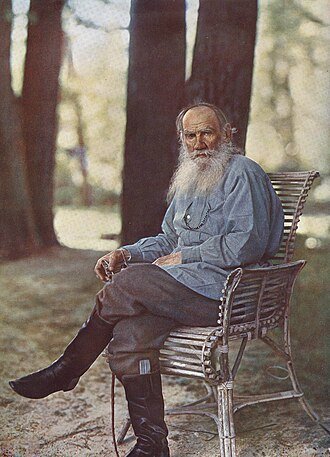 AuthorLeo Tolstoy1828–1910
A Confession is a short work by Leo Tolstoy, written between 1879 and 1880 when the author was in his early fifties. It takes the form of an autobiographical account of the existential crisis he went through in middle age, a crisis that led him to ask what the meaning of life is when death is certain. Tolstoy claims that without an answer to that question life had become impossible for him, despite his love for his family and his literary work.
The text opens with an Oriental fable: a man pursued by a beast falls into a well where a dragon waits, and he clings to a branch gnawed by two mice, one black and one white, symbols of night, day and the relentless passage of time. In this predicament he finds a few drops of honey, which in the original tale he enjoys. Tolstoy, however, can no longer take pleasure in what those drops stand for, because the certainty of death drains every joy from life.
He then examines four possible attitudes. Ignorance would make life bearable, but he can no longer ignore death. Epicureanism allows one to enjoy the time one has, yet he finds it morally untenable, since it depends on a wealth that only a minority possesses. Suicide would be the most logically consistent response if God does not exist, though he admits he lacks the courage to carry it out. The fourth option, the one he adopts, is to go on living despite the absurdity. After failing to find an answer in classical philosophical proofs of God's existence, he arrives at a more mystical, intuitive affirmation: when he says "God is life", life is once again filled with meaning. An epilogue describing a later dream suggests the spiritual transformation he underwent.
The book was conceived as the introduction to a larger set of theological writings. Its first publication in 1882 was heavily cut by Orthodox church censorship, and the complete text appeared in Geneva in 1884. It has been widely discussed in the study of religious experience, notably by William James in The Varieties of Religious Experience.
Themes
Other works by Leo Tolstoy
- Childhood 1852
- Sebastopol Sketches 1855
- War and Peace 1869
- Anna Karenina 1877
- The Kreutzer Sonata 1889
- What Is Art? 1897
- Resurrection 1899
- Father Sergius 1911
- The Devil 1911
- Hadji Murat 1912
- The Kingdom of God Is Within You
Original Filopedia text based on Wikipedia (en) and Wikidata.