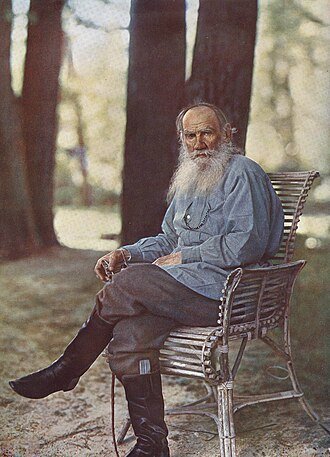
 AuthorLeo Tolstoy1828–1910
What Is Art? is an essay by Leo Tolstoy, completed in Russian in 1897 and first published in English in 1898, since the Russian censors made publication in Russia difficult. Tolstoy wrote it from a simple but uncomfortable question: the time, effort, public funds and social respect devoted to art and artists were enormous, yet no one could say precisely what was meant by art, and still less which art was good enough to deserve such sacrifices.
The book's central claim starts from a broad and deliberately unpretentious definition: art begins when a person, wishing to share with others a feeling he or she once experienced, recalls it within and expresses it through external signs. On this basis a joke, the decoration of a home or a church service can all count as art, insofar as they convey emotion. Tolstoy adds that the definition is also amoral: what matters is that the feeling infects the reader or viewer, whether it is noble or base. To judge quality, however, he applies a strict standard. Good art is the kind that moves humanity forward by replacing lower feelings with kinder ones, just as true knowledge displaces error.
From this standpoint Tolstoy distinguishes Christian art, grounded in the brotherhood of men and the consciousness of being children of God, from court or commercial art, which he accuses of seeking pleasure, social distinction or applause. His verdicts on the great names are severe and intentionally provocative: he rejects or qualifies figures such as Beethoven, Wagner, Shakespeare and Dante, and even much of his own writing, while proposing as models works of plain style and moral clarity. Among the examples he praises are novels and stories by Schiller, Hugo, Dickens, Harriet Beecher Stowe and Dostoevsky, along with paintings that depict working people with respect.
The essay also denounces the faults that, in his view, had corrupted modern art: borrowed commonplaces, a descriptive realism that smothers feeling under detail, the pursuit of striking effects, and an intellectual play that obliges the reader to decode a work rather than feel it. He blames much of this corruption on the alliance between the institutional Church and the wealthy classes after the Crusades, and on the Renaissance cult of antiquity, which he believes enthroned beauty and pleasure as supreme criteria. Tolstoy then dismantles the aesthetic theories of his day, from Baumgarten and Kant to Hegel, Hume and Schopenhauer, arguing that beneath their differences all reduce beauty to a kind of pleasure, which makes an objective definition of art impossible.
The essay's reception has been contentious. Many readers regard it as a landmark of moral criticism of art and a precursor of debates about committed art and the social function of literature. Others find it excessively rigid, unable to acknowledge the value of works Tolstoy himself rejected. Its character as a personal manifesto, written by an author who had already turned from fiction toward a religious quest, gives the book a tone that is at once passionate and contradictory, and it remains a subject of debate.
Themes
Books to read
- What Is Art? EnglishEPUB 293 KBRead online
Other works by Leo Tolstoy
- Childhood 1852
- Sebastopol Sketches 1855
- War and Peace 1869
- Anna Karenina 1877
- A Confession 1882
- The Kreutzer Sonata 1889
- Resurrection 1899
- Father Sergius 1911
- The Devil 1911
- Hadji Murat 1912
- The Kingdom of God Is Within You
Original Filopedia text based on Wikipedia (en) and Wikidata.