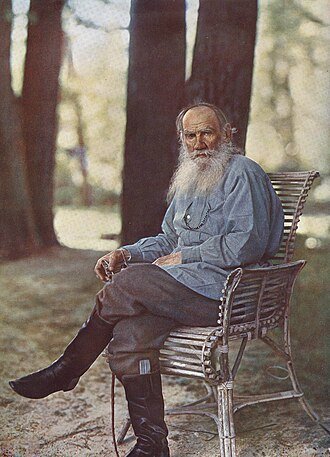
 AuthorLeo Tolstoy1828–1910
Hadji Murat is a novella by Leo Tolstoy, written between 1896 and 1904 and published posthumously in 1912, although the full text did not appear until 1917. It is the last major narrative work of its author, and its protagonist gives the story its name: a rebel commander from the Caucasus who, driven by revenge and the wish to save his family, enters an uneasy alliance with the Russians he had been fighting alongside Shamil, the leader of the resistance against the Russian Empire.
Tolstoy sets the story in the Caucasian mountains in the mid-nineteenth century, when Russian imperial expansion sought to subdue the Chechen and Dagestani tribes. The author knew the region well from his own military service there in the early 1850s, and in a letter to his brother he already mentioned a certain Hadji Murad who had surrendered to the Russian government. Decades later, when he composed the work, he drew on a wide range of material: Russian archival documents, newspapers, memoirs and correspondence from the period. The writing gained momentum in his final years, when he believed he would never be able to publish it, given its criticism of Tsar Nicholas I and of Russian policy in the Caucasus.
The narrative opens with the image of a crushed thistle that nonetheless remains standing, and from it the narrator recalls the figure of Murat. The plot follows his flight from Shamil, his refuge in a loyal village and his arrival at the Russian fortress of Vozdvizhenskaya, where he hopes to gain support to defeat his former leader and free his mother, wives and children. Along the way the book interweaves digressions on the lives of Russian soldiers, such as the young Petrukha Avdeyev, and satirically portrays imperial bureaucracy and the vanity of the tsar. Toward the end the story moves forward to Murat's death in a desperate last stand.
The work differs from Tolstoy's other late writings, such as Resurrection or The Kreutzer Sonata, because it does not pursue a moral purification of its characters. Instead it portrays the darker side of human nature and casts doubt on whether anything divine resides in people. Its central theme is the individual's resistance to forces that seek to bend him, symbolised by the thistle, which can be uprooted only by destroying it. Alongside this appear determinism, already present in War and Peace, and the opposition between a Europeanised Russia and a Muslim East.
The novella was received as one of its author's most sober and realistic works, often compared to Pushkin's The Captain's Daughter for its grounding in real people and events. Its late publication allowed it to be read as both a literary and a historical testimony to the Caucasian War.
Themes
Other works by Leo Tolstoy
- Childhood 1852
- Sebastopol Sketches 1855
- War and Peace 1869
- Anna Karenina 1877
- A Confession 1882
- The Kreutzer Sonata 1889
- What Is Art? 1897
- Resurrection 1899
- Father Sergius 1911
- The Devil 1911
- The Kingdom of God Is Within You
Original Filopedia text based on Wikipedia (es) and Wikipedia (en) and Wikidata.