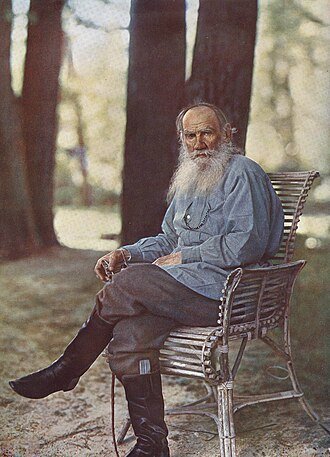
 AuthorLeo Tolstoy1828–1910
War and Peace is a novel by the Russian writer Leo Tolstoy (1828-1910), regarded together with Anna Karenina as the summit of his work and one of the great classics of world literature. Tolstoy began writing it in 1863, shortly after his marriage and his settling on his country estate, and revised it over several years. An early version, titled 1805, appeared in serial form in The Russian Messenger between 1865 and 1867; the definitive version was published in full in 1869.
The book recounts the French invasion of Russia and its aftermath, covering roughly fifty years of Russian history from the Napoleonic Wars to the mid-nineteenth century. It interweaves the stories of several aristocratic families, among them the Bezukhovs, the Bolkonskys, the Rostovs and the Kuragins, alongside historical figures such as Napoleon, Tsar Alexander I and General Kutuzov. Its central characters are Prince Andrei Bolkonsky, intelligent and skeptical; Pierre Bezukhov, an illegitimate son of sincere kindness but social awkwardness who becomes heir to a great fortune; and Natasha Rostova, a lively young woman whose life is shaped by war and by the vicissitudes of love.
The novel alternates scenes of aristocratic salons, balls and conversation with battles such as Austerlitz and Borodino and the occupation of Moscow. Tolstoy depicts the conflict with a viewpoint that moves easily between a panoramic vision of events and the intimate perspective of his characters, with a visual precision often compared to cinema. Yet the work is not confined to fiction: in its later books and in the epilogue, the author interposes essays questioning traditional historiography, especially military history, and reflecting on the role of individuals before great historical forces. This blend of narrative and philosophical discourse was unconventional in its time and has been debated ever since.
Tolstoy himself resisted classifying the work strictly as a novel, and its title has also prompted interpretation: it has been linked to Proudhon's 1861 work and to a passage in Suetonius about the emperor Titus, though the author never fully explained his choice. The book was widely received from the start, and its translation into many languages soon made it a global reference, admired both for its breadth of characters and for its portrait of Russian society.
Themes
Books to read
- War and Peace EnglishEPUB 1,7 MBRead online
Other works by Leo Tolstoy
- Childhood 1852
- Sebastopol Sketches 1855
- Anna Karenina 1877
- A Confession 1882
- The Kreutzer Sonata 1889
- What Is Art? 1897
- Resurrection 1899
- Father Sergius 1911
- The Devil 1911
- Hadji Murat 1912
- The Kingdom of God Is Within You
Original Filopedia text based on Wikipedia (es) and Wikipedia (en) and Wikidata.