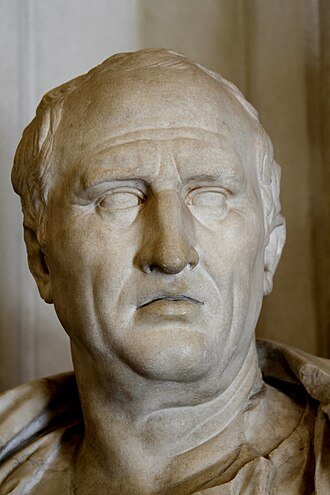
 AuthorCicero106 BC–42 BC
De oratore, whose full title is Dialogi tres de oratore (Three Dialogues on the Orator), is a treatise on rhetoric written by Cicero in Latin around 55 BC, divided into three books. It belongs to the so-called rhetorical trilogy, together with the Brutus and the Orator, and its first book is addressed to his brother Quintus Tullius Cicero.
Cicero conceived it as a response to the moral and political decline of the Roman Republic, in an age marked by street violence, civil wars and the loss of public life that he himself had suffered. To give the text a serene tone, he modelled it on Plato's dialogues: the conversation is set in 91 BC at Lucius Licinius Crassus's country villa in Tusculum, with historical figures such as Crassus, Marcus Antonius, Scaevola and Sulpicius Rufus. This framing allowed him to move away from an arid exposition of rules and open the discussion toward philosophical and ethical questions.
The central argument is that the ideal orator is not merely a skilled speaker but a man of wide learning in law, history and philosophy, with moral virtue. Cicero holds that the power of persuasion is decisive for the community and that, in the hands of someone without principles, it can be dangerous. The text therefore surveys the classical parts of oratory: inventio, dispositio, elocutio, memoria and actio, giving particular attention to the last, which was decisive before the Senate and the courts. It also includes one of the earliest surviving descriptions of the method of loci, a mnemonic technique.
Despite the importance Cicero attached to it as a definitive theory of oratory, the work had little immediate influence, and the teaching of rhetoric relied more on simpler pedagogical manuals. Over time, however, it became one of the fundamental references of Renaissance humanism.
Themes
Other works by Cicero
Original Filopedia text based on Wikipedia (es) and Wikipedia (en) and Wikidata.