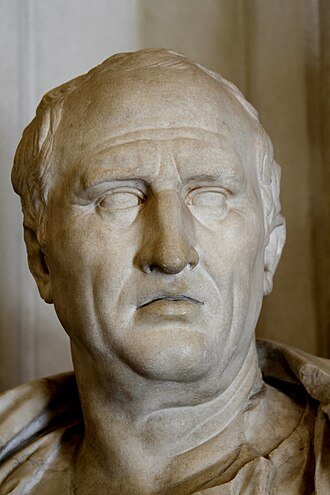
 AuthorCicero106 BC–42 BC
De finibus bonorum et malorum is a philosophical work by Marcus Tullius Cicero, written in five books during the summer of 45 BC over roughly six weeks. Cicero composed it amid political turmoil and after the death of his daughter Tullia, and dedicated it to Marcus Junius Brutus. Together with the Tusculan Disputations and the Academica, it is among his most extensive philosophical works.
Its central theme is the question of the highest good, that which makes a human being happy and is sought for its own sake. The work falls into three parts. In the first two books, a young Epicurean presents the doctrine of Epicurus, which identifies pleasure with the absence of pain; Cicero criticizes it and argues that this condition cannot be the ultimate end. In the third and fourth books, Cato expounds Stoicism, which holds that moral virtue is the only good, and Cicero questions this thesis and the exclusion of other goods it entails. In the fifth book, Cicero presents the synthesis of Antiochus of Ascalon, which combines virtue with external goods, and subjects it to criticism while expressing sympathy for it.
The method is dialogue, with interlocutors defending each school and the confrontation between them as the organizing principle. The work was highly influential in transmitting Hellenistic thought into Latin, since it introduced much of the technical Stoic vocabulary into that language. Curiously, its text gave rise to the pseudo-Latin filler known as lorem ipsum, used as placeholder text in typography.
Themes
Other works by Cicero
Original Filopedia text based on Wikipedia (es) and Wikipedia (en) and Wikidata.