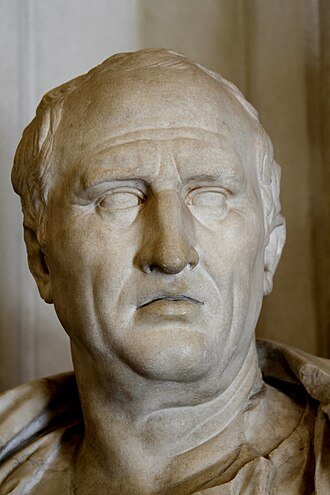
 AuthorCicero106 BC–42 BC
On the Laws is a Socratic dialogue written by Marcus Tullius Cicero around 52 BC, during the last years of the Roman Republic. It takes its title from Plato's dialogue of the same name. Unlike his earlier work De re publica, in which he set the conversation in the time of Scipio Aemilianus, Cicero wrote it as a fictional exchange between himself, his brother Quintus and their friend Titus Pomponius Atticus, who stroll together through the family estate at Arpinum while discussing how laws ought to be.
Three books survive, although the original number is uncertain. The first expounds the doctrine of natural law, rooted in Stoic thought, according to which law does not arise from mere human convention but from the reason shared by all people with a higher power. For Cicero justice is eternal, whereas written laws are temporary and imperfect, and should approximate justice as closely as possible. The second book deals with religious law, which he seeks to reconstruct from the oldest Roman traditions, and the third describes the powers of the various magistracies and proposes an organisation of the state.
The project is strongly conservative: Cicero idealises a Rome before the Gracchi, when the social classes lived in harmony, and aims to reform the worst features of the constitution rather than overthrow it. Shortly after the date traditionally given for its composition, the civil war launched by Julius Caesar brought the Republic to an end, so its practical application never materialised. Its later influence was nonetheless considerable, particularly on the tradition of natural law and on Western political thought.
Themes
Other works by Cicero
Original Filopedia text based on Wikipedia (es) and Wikipedia (en) and Wikidata.