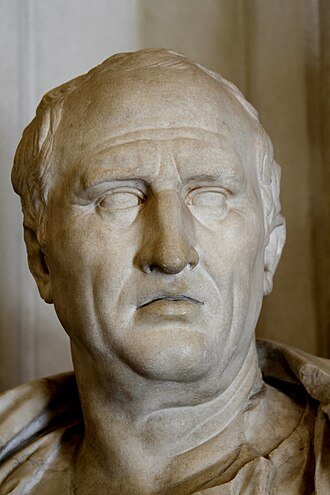
 AuthorCicero106 BC–42 BC
De Natura Deorum (On the Nature of the Gods) is a philosophical dialogue by Cicero, written in 45 BC, in three books that examine the theological views of the Hellenistic schools. Cicero composed it in the last two years of his life, partly to relieve the political inactivity imposed on him by Caesar's supremacy and partly to cope with grief over the death of his daughter Tullia. The dialogue is set in the fictional period between 77 and 75 BC, when Cicero was still young, at the house of Gaius Aurelius Cotta, a pontifex.
Cicero narrates the work and takes little active part in the discussion. Gaius Velleius speaks for Epicureanism, Quintus Lucilius Balbus defends the Stoic view, and Gaius Cotta, who represents the Academic Skepticism that Cicero himself favoured, criticises both. The first book contains the introduction, the Epicurean account and Cotta's critique. The second sets out Balbus' Stoic explanation of the gods, including the four causes Cleanthes gave for religious belief and the argument for a rational, providential cosmos. The third gathers Cotta's objections, which extend to mythology and to the idea that providence cares for humans. The dialogue ends without a firm verdict: Cicero inclines to think Balbus comes closer to the truth, but leaves the question open.
The work shows inconsistencies and gaps suggesting Cicero never revised it and that it was published after his death. It draws heavily on earlier Greek sources, and its hasty arrangement means some objections go unanswered. Even so, it was widely read: Christian writers knew it, Hume modelled his Dialogues Concerning Natural Religion on it, and Voltaire admired it greatly. Today it is a key source for Epicureanism, Stoicism and Academic Skepticism, since it preserves material that would otherwise be lost.
Themes
Other works by Cicero
Original Filopedia text based on Wikipedia (es) and Wikipedia (en) and Wikidata.