Critique of Pure Reason
philosophical treatise on epistemology and metaphysics · 1781
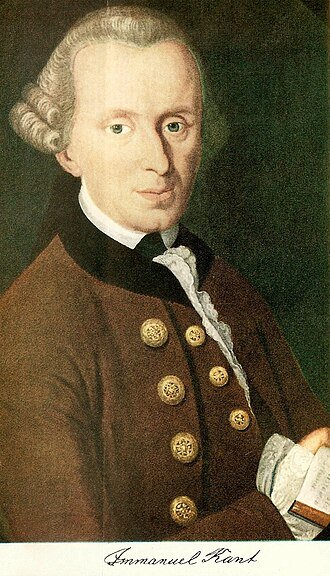 AuthorImmanuel Kant1724–1804
The Critique of Pure Reason (Kritik der reinen Vernunft) is the central work of the Prussian philosopher Immanuel Kant. It appeared in 1781, and Kant substantially revised it in a second edition published in 1787. It is also known as the "First Critique", since it was followed by the Critique of Practical Reason (1788) and the Critique of Judgment (1790). Its aim is to determine the limits and scope of human reason and to settle once and for all whether metaphysics can count as a science.
Kant wrote against the background of the clash between rationalism, which trusted reason to reach truths about God, the soul and the world, and empiricism, which held that all knowledge comes from experience. His starting point was the skepticism of David Hume, who had questioned the basis of the principle of causality, and with it the foundation of scientific knowledge. Kant later acknowledged that Hume had roused him from his "dogmatic slumber". He resolved to find an answer and spent years on the problem, although the book was set down in written form in a comparatively short time.
The heart of the work is the distinction between analytic and synthetic judgments, and between a priori and a posteriori knowledge. An analytic judgment is one whose predicate is already contained in the concept of its subject, whereas a synthetic judgment adds new information. Kant argues that mathematics, the first principles of natural science and metaphysics all contain synthetic a priori judgments: universal, necessary and independent of experience. The central question of the book is how such judgments are possible. To answer it, Kant proposes a "Copernican turn": it is not our knowledge that conforms to objects, but objects that must conform to the forms of our mind. He therefore distinguishes between phenomena, things as they appear to us, and noumena, things in themselves, which we can never know.
The work is organized into an Introduction and two main parts. The "Transcendental Doctrine of Elements" contains the Transcendental Aesthetic, which studies sensibility and the a priori forms of space and time, and the Transcendental Logic, divided into the Transcendental Analytic, devoted to the pure concepts of the understanding, and the Transcendental Dialectic, which examines the illusions into which reason falls when it seeks the unconditioned, such as the soul, the world and God. The "Transcendental Doctrine of Method" closes the book. Kant concludes that dogmatic metaphysics cannot establish itself as a science, although the critique itself lays the groundwork for a new way of doing philosophy.
Its early reception was slow and confused, but it soon became a landmark. Empiricists and rationalists alike criticized it, and it gave rise to German idealism in the work of Fichte, Schelling and Hegel, shaping much later philosophy. Its influence today reaches epistemology, the philosophy of science, ethics and aesthetics. As a curious footnote to its reception, in 1827 the Congregation of the Index, of which the future Pope Pius VIII was prefect, forbade its reading under threat of excommunication.
Themes
Books to read
- The Critique of Pure Reason EnglishEPUB 498 KBRead online
Other works by Immanuel Kant
Original Filopedia text based on Wikipedia (es) and Wikipedia (en) and Wikidata.